
Match Renovation Loans in Australia to Project Size and Builder Needs
- Yorgo

- 15 hours ago
- 8 min read

The cheapest money for your renovation is almost always the money you already have. After that, the order runs home loan top-up or refinance, then a construction loan if the work is structural, then a personal loan for smaller jobs with no spare equity, then green finance if your project qualifies. Check your equity and get a lender pre-approval or a fixed-price builder quote before you commit to anything.
TL;DR:
Home equity redraw and offset accounts are typically the cheapest options for financing renovations, provided you already have the funds sitting there.
Construction loans are required for structural work and involve staged fund release tied to building milestones, with detailed contracts essential to avoid delays.
Personal loans are suitable for small projects under $30,000, but usually carry higher interest rates, making them less cost-effective for larger jobs.
Green finance and government programs are available for energy-efficient upgrades and flood resilience projects, but eligibility depends on specific criteria and approved technologies.
Proper preparation, including detailed quotes, lender pre-approval, and clear milestone contracts, is crucial to prevent delays and ensure smooth funding during renovations.
Table of Contents
What are the renovation loan options in Australia?
Most Australian homeowners choose between five broad routes, and the right one depends almost entirely on project size, whether the work is structural, and how much equity sits in the property already.
Savings, redraw or offset: no new borrowing, no application, and no extra interest, but only works if you’ve got the funds sitting there.
Home loan top-up or refinance: taps existing equity at your mortgage rate, typically the cheapest borrowed option, but requires a valuation and lender approval.
Construction or renovation loan: purpose-built for structural work, released in stages, generally similar rates to a standard mortgage but with more paperwork.
Personal loan (unsecured): fast approval, no equity needed, but comes with a noticeably higher interest rate.
Green finance (HEUF and similar): discounted rates for eligible energy upgrades, but narrow eligibility criteria.
Credit cards or buy-now-pay-later: fine for a $1,500 tapware upgrade, a disaster for anything involving a builder and a permit.
The general rule holds across almost every renovation budget in the country: cheaper money sits closer to your existing mortgage, and cost climbs the further you move from secured, equity-backed lending. That’s the filter to apply before you even start comparing individual products.
Using home equity: redraw, offset, top-up and refinancing
If you’ve been paying down your mortgage for a few years, there’s a good chance your home is quietly sitting on a pile of usable equity, and this is where most sensible renovation finance conversations start.
Redraw and offset accounts are the simplest form of this. If you’ve made extra repayments, a redraw facility lets you pull that money back out, often with no new application at all. An offset account works differently but achieves something similar: the cash sits there reducing the interest calculated on your loan until you need it for tradies and materials.
A top-up or cash-out refinance goes a step further. You’re increasing your existing home loan (or refinancing to a new one) against the equity built up as your property value has risen and your balance has fallen. Lenders generally cap this at 80 to 90% of your property’s value, loan to value ratio, though some will stretch further with mortgage insurance attached. The catch is that a bigger loan balance means bigger repayments, spread over your remaining mortgage term, so it’s worth running the numbers on what that extra amount actually adds to your monthly budget rather than assuming it disappears into the noise.
Getting this moving typically means:
Order a valuation, either through your existing lender or an independent valuer, to confirm current equity.
Pull together recent payslips, your latest mortgage statement, and evidence of any other debts.
Decide whether to go through your existing bank directly or use a broker who can compare top-up terms across lenders.
Confirm the exact amount you need against your builder’s written quote, not a rough guess.
Pro Tip: Have your builder’s fixed-price quote in hand before you call the bank. Lenders move faster and offer cleaner terms when the borrowing amount is backed by a real number, not an estimate you’re still working out.
Construction loans: staged drawdowns and site checks
Structural work changes the lending conversation entirely. Knocking out a load-bearing wall, adding a second storey, or extending the footprint of your home typically pushes you out of standard top-up territory and into a construction loan, because lenders treat structural risk differently from cosmetic upgrades, as Westpac’s guidance on renovation loans makes clear.
Construction loans release funds in stages, tied to defined building milestones such as slab down, frame up, lock-up, and fit-out. Banks generally require a site inspection and builder-supplied evidence before each drawdown lands, according to the Commonwealth Bank’s construction loan guide. You pay interest only on the amount drawn so far, not the full approved loan, which keeps repayments manageable during the build. Once construction wraps up, the loan typically converts to a standard principal and interest mortgage.
Before you apply, have these ready:
A fixed-price building contract, not a rough estimate on letterhead.
Confirmation your builder holds the correct state licensing.
Development approval or a complying development certificate if your council requires one.
Evidence of builder’s insurance and, where relevant, home warranty insurance.
Roughly a third of construction finance delays trace back to vague milestone definitions in the building contract, where lender and builder disagree on what “lock-up” actually means. Nailing down milestone definitions in the contract itself, matched to what your lender expects to inspect, avoids most of that friction before it starts.
When do personal loans make sense for renovations?
A personal loan suits the jobs that don’t justify touching your mortgage at all: a new bathroom vanity, external repainting, a small deck, or landscaping under roughly $30,000. It’s unsecured, so there’s no equity requirement and no valuation, and approval can land within a day or two rather than weeks.
The trade-off is cost. Lenders advertise a headline rate, but ASIC warns consumers to check the comparison rate instead, since it folds in most standard fees and gives a far more honest picture of what the loan actually costs across its term. Personal loan rates commonly sit closer to 10% for many borrowers, well above typical variable home loan rates, according to independent finance comparisons.
Run the numbers on a $30,000 renovation and the gap becomes obvious. On a five-year personal loan near 10%, you’re looking at meaningfully higher total interest than adding the same amount to a mortgage top-up spread over 20 or more years at a lower rate, even though the mortgage option technically costs more in total interest paid over its longer life. There’s no single right answer here. It depends on how quickly you want the debt gone.
Check the comparison rate, not the advertised rate, on every personal loan you consider.
Confirm the loan term matches how quickly you genuinely want to clear the debt.
Pro Tip: Save credit cards and buy-now-pay-later for genuinely small, short-term purchases, think fixtures and paint, not the builder’s invoice. The interest on unpaid card balances will outpace almost any other finance option on this list.
Green finance and government renovation programs
The Household Energy Upgrades Fund is a $1 billion federal program offering discounted finance for home energy efficiency upgrades through participating banks and specialist lenders. It’s designed to cover work like solar PV installation, battery storage, and insulation upgrades, and the discount can be genuine, shaving a meaningful margin off a standard loan rate for eligible projects.
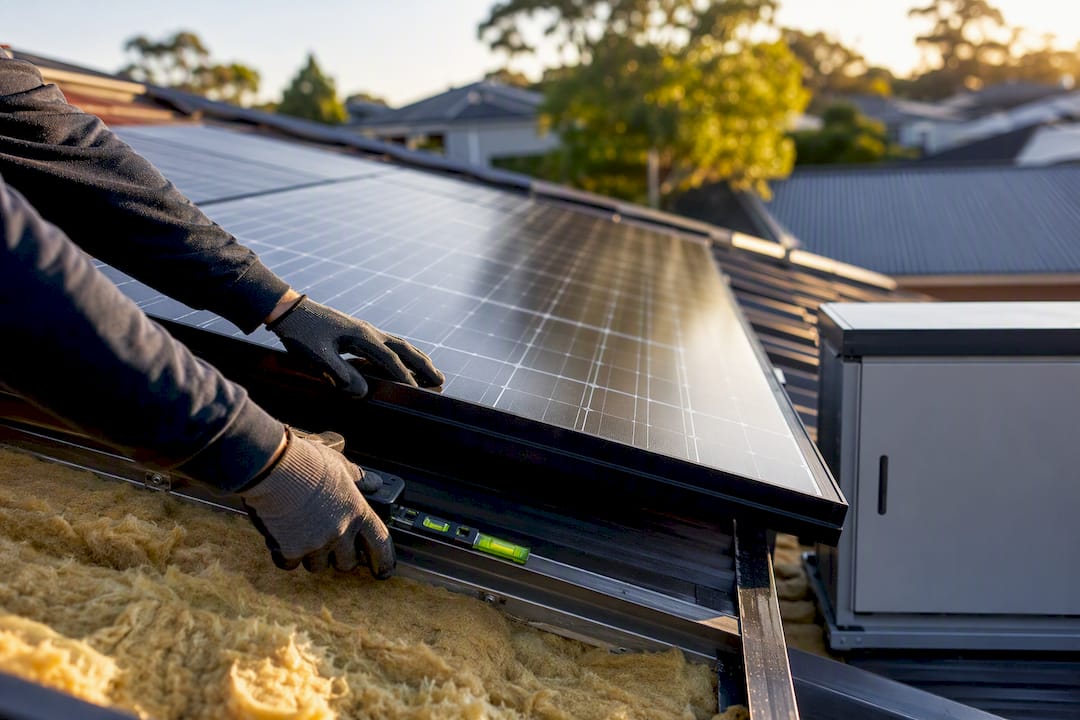
The catch is eligibility. HEUF products vary by lender and generally require the upgrade to sit on an approved technology list, often backed by an energy assessment showing the work actually improves efficiency. It’s not a general-purpose renovation discount, it’s targeted finance for specific energy outcomes.
State-based programs add another layer, though they’re often narrower still. The NSW Resilient Homes Program offers grants and matched contributions for flood-resilience retrofit work in eligible areas, with its own application windows, grant caps, and milestone claim rules.
Confirm your upgrade sits on the approved technology list before assuming HEUF eligibility.
Ask your lender directly whether they participate in HEUF; not all do.
Check whether a state program applies to your postcode and project type before ruling it out.
How lenders assess a renovation loan application
Every lender is really asking two questions: can you service this debt, and is the project itself credible? Getting your paperwork in order before you apply speeds up both.
Expect to provide:
Proof of income, payslips or two years of tax returns if you’re self-employed.
Statements for any existing loans, including your current mortgage balance.
Full property details and, in many cases, a fresh valuation.
A written builder contract with a staged invoice schedule matching the loan drawdown structure.
Any council approvals the project requires.
Beyond the numbers, lenders look hard at loan to value ratio and scope clarity. A vague one-page quote raises more questions than a detailed, itemised contract does. Builder credentials matter too, and state licensing checks, such as those enforced under QBCC’s domestic building contract rules in Queensland, where a written contract is mandatory for work above $3,300, give lenders (and you) genuine consumer protection if something goes wrong mid-build. Variations to scope after approval are one of the most common causes of stalled drawdowns, since the lender is financing the contract as originally submitted, not whatever it grows into.
Pro Tip: Ask your builder for a staged invoice format that mirrors your lender’s drawdown milestones exactly. Mismatched terminology between contract and loan paperwork is a small thing that causes surprisingly large delays.
A pre-application valuation, arranged before you formally apply, can also flag equity shortfalls early, well before they become a rejection letter.
Budgeting by project scale: a worked example
Rough project bands help match the finance to the job. Cosmetic work under $30,000, a new kitchen splashback, repainting, minor landscaping, usually suits savings or a personal loan. Medium projects between $30,000 and $150,000, a bathroom renovation or a modest extension, generally point toward a home loan top-up. Major work above $150,000, full extensions, second storeys, knockdown rebuilds, typically needs a construction loan.
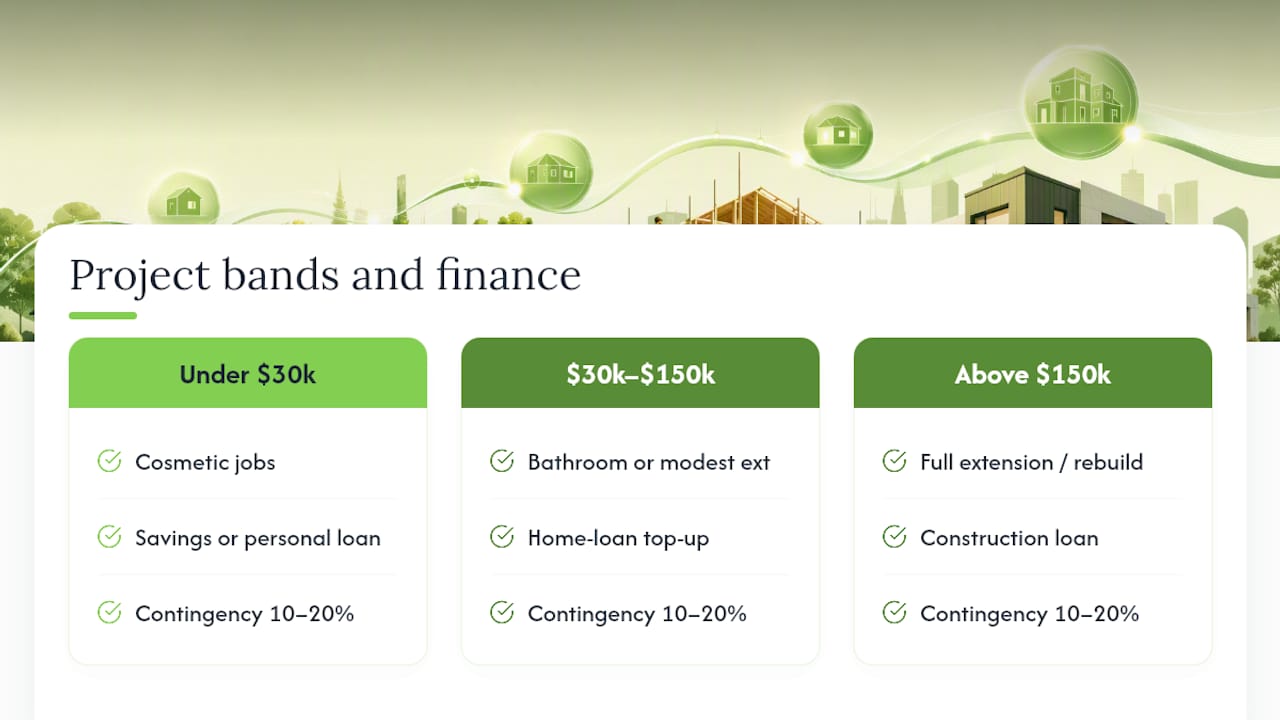
Build in a contingency of 10 to 20% on top of your quoted price. Council permit timing and material lead times can shift drawdown schedules, and ABS building activity data shows how much construction demand fluctuates market-wide, which flows through to both cost and timing.
Take a $200,000 extension as an example: roughly $20,000 released at slab, $60,000 at frame, $60,000 at lock-up, and $60,000 at completion. Interest is charged only on funds drawn at each stage, not the full amount upfront.
Builder insight: reducing lender friction on site
We see the gap between a smooth drawdown and a stalled one from the builder’s side, and it almost always comes down to evidence. Lenders want photographic proof, signed inspection reports, and invoices that match the milestone being claimed. A builder who supplies that promptly keeps your progress payments moving.
Fixed-price contracts remove most disputes before they start, because everyone, lender included, is working from the same number. Cost-plus arrangements can suit complex heritage work, but they demand tighter communication to avoid surprises at drawdown time. At Yorcon, we manage that evidence trail and the client conversation around variations as one process, not two separate headaches. If you’re weighing up a structural renovation against something purely cosmetic, that distinction is exactly what shapes which finance route suits you.
If you’re planning a major extension or a full renovation and want a builder who handles progress payment schedules alongside the actual construction, our home extensions and home renovations teams work directly with lenders’ documentation requirements from the first quote. For heritage properties, our heritage renovation team understands the added contract detail older homes often need.
Author perspective: what I’d check before signing anything
Confirm your builder’s licensing before you fall for a beautiful render. Get a fixed-price quote, not a “rough figure,” and take it to your lender for pre-approval before you sign anything. Build in a genuine 15% contingency, not the bare minimum, because renovation surprises are the rule, not the exception. Insist on a milestone schedule written into the contract in the same language your lender uses for drawdowns.
Do this first: check your equity, get one detailed quote, and have a single conversation with your lender before you commit to a start date. Most of the finance headaches homeowners describe trace back to skipping one of those three steps.
— Matthew
Sources
Recommended


