
Australian Homeowners: When a Building Estimate Becomes Binding


A quote is a fixed-price offer that becomes a legally binding contract once you accept it. An estimate is an indicative figure, useful for early budgeting, but not something a builder is bound to honour. If you are ready to commit to a project, ask for a written, itemised quote, not an estimate. Signing off on vague paperwork is exactly how disputes over “surprise” costs start.
TL;DR:
Homeowners should verify whether a document is an estimate or a quote because only a fixed-price quote becomes legally binding once accepted.
Detailed estimates often look comprehensive but remain non-binding unless the wording and conduct indicate an intent for a fixed price.
Comparing quotes requires matching plans, reviewing line-by-line inclusions and exclusions, and ensuring validity periods and payment schedules are clearly stated.
Before signing, clients must confirm in writing whether a document is an estimate or quote, and request full documentation, including warranties and contract terms.
Relying solely on estimates risks price increases due to site conditions or design changes, so obtaining a fixed, itemised quote is essential for legal and financial protection.
Table of Contents
Publisher perspective: how an experienced builder manages this transition
How long do estimates and quotes last, and what do they cost to produce?
How do you negotiate with a builder using estimates and quotes?
Editorial take: what homeowners get wrong about this whole process
How Yorcon turns your estimate into a signed, itemised quote
What is a building estimate?
A building estimate is a rough figure a builder gives you before they’ve done enough homework to price the job properly. Builders typically issue estimates at the feasibility stage, before detailed drawings exist or before a full site inspection has happened. Think of it as a builder’s educated guess based on similar projects, not a promise.
A genuine estimate usually includes:
A price range rather than a single fixed figure
High-level assumptions about site conditions, materials, or access
Provisional items flagged as “subject to confirmation”
A note stating the figure is indicative and may change
The trap for homeowners is that some estimates look extremely detailed, complete with line items and sub-totals, while still carrying “indicative” or “approximate” language buried in the fine print. A polished layout does not make a document binding. According to industry guidance on the estimate to quote workflow, builders often issue detailed estimates early simply because a proper quote requires intrusive inspections and time they haven’t yet invested. That’s a legitimate reason to give you an estimate. It’s not a reason to treat it as a price you can bank on.
What is a building quote, and when does it become binding?
A proper quote is a fixed-price offer. Once you accept it, in most cases it forms a binding contract, which is a very different legal position from an estimate. Official guidance on quotes and estimates confirms this distinction: quotes are detailed assessments that fix a price, while estimates remain indicative figures subject to change.
A quote worth signing should include:
An itemised scope of works, not a lump sum with no breakdown
A payment schedule tied to project milestones
A clear “valid until” date
An explicit GST statement (inclusive or exclusive)
A list of what’s excluded, not just what’s included
Once you accept a quote, it typically feeds into a formal contract, often built on an HIA or MBA standard form, which sets out the legal terms governing the build. The “valid until” date matters more than most homeowners realise. It protects the builder from material cost blowouts if you sit on the quote for three-months, and it protects you from a builder trying to reprice the job after you’ve already made decisions based on their number. A quote without exclusions listed and without a validity date is a red flag, not a courtesy shortcut.
When can an estimate be treated as legally binding?
This is where a lot of homeowners get caught out. Labelling a document “estimate” does not automatically protect a builder from being held to that price. Courts look at the wording and the conduct of both parties, not just the heading on the page.
In Kyren Pty Ltd v Built Projects Pty Ltd [2006] SASC 204, the court examined exactly this question: whether a document called an “estimate” carried the weight of a fixed commitment. The outcome turned on the specific wording and how the parties behaved afterwards, not the label alone.
If a builder issues a detailed, itemised document and then proceeds to build strictly to that figure without flagging changes, a court may treat that conduct as evidence the parties intended a fixed price, regardless of what the document was called.
Legal commentary from Fenwick Elliott Grace makes the same point: estimates are usually non-binding, but not always, and consistent, careful labelling is your best defence against ambiguity either way.
The practical safeguard is simple. If you’re the homeowner, ask the builder to state plainly, in writing, whether the document is an estimate or a quote, and keep every version they send you. If you’re relying on an estimate for a bank pre-approval or a budget decision, get it in writing that it is indicative only, so nobody can later claim otherwise.
How do you compare quotes and estimates properly?
Consumer Affairs Victoria recommends getting at least three written, detailed quotes based on the same plans and specifications. Comparing a rough estimate against a detailed quote tells you nothing useful. You need to compare like with like.
Confirm every quote is based on identical drawings. If one builder quoted off a sketch and another off finished architectural plans, the numbers aren’t comparable, no matter how close they look.
Go line by line through inclusions, exclusions, and provisional sums. This is where the real cost differences hide. A cheaper quote that excludes site preparation, waste removal, or council fees isn’t actually cheaper.
Check validity periods, warranty terms, insurance, and subcontractor allowances. Note any vague wording like “approximately” or “to be confirmed” sitting inside what’s supposed to be a fixed quote.
Compare payment schedules and what triggers each progress claim. A schedule front-loaded with large early payments before much work is done is worth questioning.
Pro Tip: Insist that provisional sums be converted to firm prices before you commit to major procurement like kitchen cabinetry or custom joinery. A provisional sum for tiling that later blows out by thousands is one of the most common sources of budget disputes on Australian renovation projects, and it’s entirely avoidable if you push for firm figures early.
Experienced homeowners scrutinise the exclusions section harder than the inclusions section, because that’s where budget blowouts actually originate, not in the headline price.
What should you ask and document before signing?
Before you sign anything, ask the builder these questions directly, and get the answers in writing:
“Is this document an estimate or a quote?”
“What exactly is excluded from this price?”
“How will variations be priced and who has to approve them before work proceeds?”
“What is the valid until date on this figure?”
Documents to collect before you sign include the itemised quote itself, the full contract terms, proof of the builder’s licence and insurance, and written warranty details. Don’t take a builder’s word on any of these; ask for copies.
If you’re proceeding on the strength of an estimate rather than a finished quote, because you need to make an early decision, set a written cap on spending or insist on a follow-up written quote before any major procurement happens. A verbal reassurance that “it won’t go over $X” means nothing in a dispute. A written cap, even an informal one in an email, gives you something to point to.
Publisher perspective: how an experienced builder manages this transition
Some experienced builders have spent close to two decades managing residential builds across Melbourne, from heritage restorations to architectural new builds; the estimate-to-quote handover is one of the most common points where trust either builds or breaks down.
Many builders treat the shift from estimate to quote as the moment a project becomes real for a client. They ensure quotes are itemised, dated, and explicit about what’s included and excluded, before clients sign anything.
Transparent, itemised quotes reduce disputes because there’s no grey area left for either party to argue about later. When variations do come up, especially on renovation projects, having a clear baseline quote makes pricing that change straightforward rather than adversarial.
How long do estimates and quotes last, and what do they cost to produce?
An estimate can usually be turned around quickly, sometimes within a day or two, because it doesn’t require a full site inspection or detailed engagement with drawings. A proper quote takes longer, often one to two weeks for a renovation or extension, because it requires a site visit, review of finished plans, and pricing from subcontractors and suppliers.
Validity periods differ too. Estimates rarely carry a formal validity date because they’re not meant to be locked in. Quotes commonly carry a validity window commonly is between two and four weeks, which protects the builder from material price rises and gives you a realistic window to make a decision.
As for cost, most builders don’t charge for an initial estimate, since it’s part of winning your business. Detailed quotes are often free too for smaller jobs, but for larger renovations or architectural builds, some builders charge a fee for the detailed quoting process, particularly where it involves engineering input, council liaison, or specialist trade pricing. That fee, when it applies, is usually credited back against the project if you proceed. Always ask upfront whether a detailed quote is chargeable, because assuming it’s free and then receiving an invoice is an unnecessary and avoidable surprise.
If a builder is quoting for a full design-and-build project, expect the quoting phase to run longer again, since it typically wraps in design development and permit considerations before a fixed price can be locked in.
Why do final quotes differ from initial estimates?
The gap between an early estimate and the final quote rarely comes from a builder trying to mislead you. It usually comes from information that simply wasn’t available yet.
Site conditions are the biggest culprit. An estimate given before excavation can’t account for rock, poor soil, or hidden drainage issues that only show up once work starts. Material price movements matter too, particularly for imported fixtures or timber, where a three month gap between estimate and quote can shift the number meaningfully.
Design changes are another common cause. If you tweak the floor plan, upgrade fittings, or add a second storey option between the estimate and the quote stage, the price should change. That’s not a discrepancy, that’s the estimate doing exactly what it was meant to do: giving you a starting point before the details were locked in.
Scope clarification also plays a role. Early estimates often bundle assumptions, like “standard tiling allowance”, that get replaced with actual client selections once you’ve chosen finishes. If your tile budget was $40 per square metre in the estimate and you select $120 per square metre stone, the final quote will reflect that, and it should.
The discrepancies worth questioning are the ones with no clear explanation, particularly where the builder can’t point to a specific site finding, design change, or client decision that drove the increase.
How do you handle scope creep after a quote is issued?
Scope creep is when small changes accumulate after a quote or estimate is locked in, and it’s the single most common source of tension on renovation projects. Every change, however minor it feels at the time, should be documented as a formal variation before work proceeds.
A proper variation process, the kind built into most standard building contracts, requires the change to be priced, put in writing, and signed off by you before the builder proceeds. If a builder starts work on a change based on a verbal “yeah, that’s fine” during a site visit, you’ve lost your paper trail the moment a dispute arises.
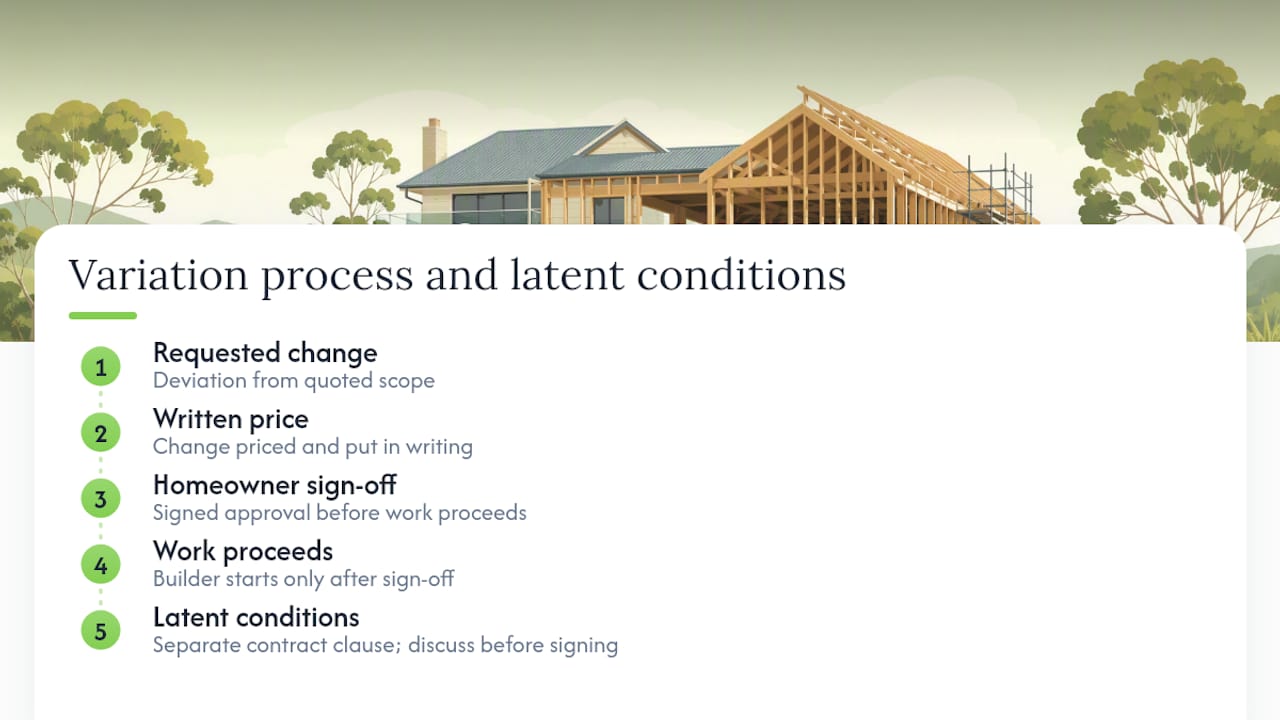
The practical habit worth building is simple: any time you ask for something different from what was quoted, whether it’s moving a power point or upgrading a benchtop, ask the builder to confirm the cost impact in writing before they proceed. If they can’t give you a number immediately, ask for a written estimate of the variation cost within a set number of days.
Latent conditions, things like unexpected asbestos, rot, or subsurface rock, sit in a slightly different category. Most formal contracts include specific clauses covering latent conditions, separate from ordinary variations, because they’re genuinely outside anyone’s control. Ask your builder to explain how their contract treats latent conditions before you sign, not after one turns up.
What are the risks of relying only on an estimate?
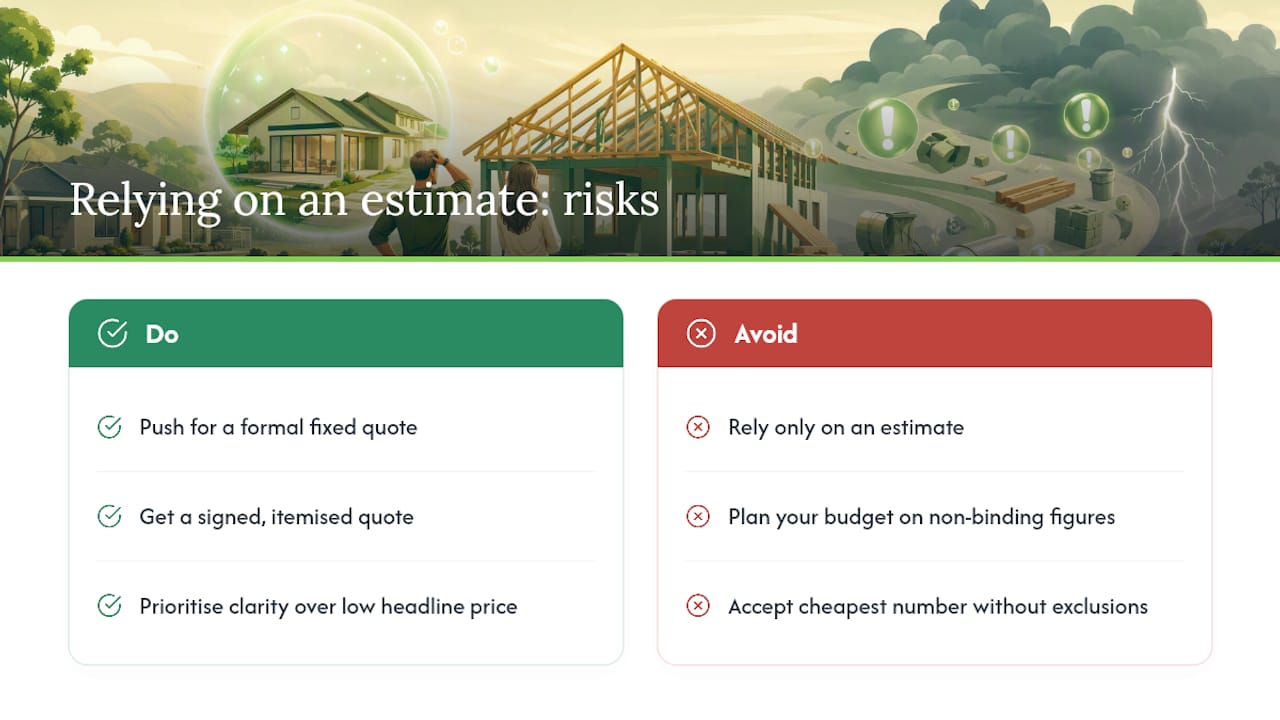
Proceeding on an estimate alone, without pushing for a formal quote, puts the financial risk squarely on you. Banks and lenders generally want a fixed quote for finance approval, not an estimate, so relying on an estimate can stall your loan process at the worst possible time.
The bigger risk is budget exposure. Because an estimate carries no binding price, a builder isn’t obligated to hold that figure if material costs rise or the scope firms up differently than expected. You might plan your renovation budget around an estimate, only to find the eventual quote sits well above it, by which point you’ve already committed emotionally, and sometimes financially, to the project.
There’s also a documentation risk. If a dispute arises and all you have is an estimate with vague, indicative language, you have far less legal standing than you would with a signed, itemised quote. Courts generally need evidence of clear intent to create a binding price, and an estimate stacked with disclaimers works against you here, not for you.
The cheapest number you’re given, whether it’s an estimate or a quote, can also be the most expensive outcome if it’s missing key exclusions or built on low-grade allowances that don’t match what you actually want in the finished home, as discussed in avoiding common pitfalls when replacing doors yourself. Clarity beats a low headline figure almost every time.
How do you negotiate with a builder using estimates and quotes?
Negotiation works differently depending on which document you’re holding. With an estimate, you have room to negotiate on scope and inclusions before anything is locked in, since nothing is fixed yet. Use this stage to ask what would happen to the price if you removed an item, chose a cheaper finish, or phased the project.
Once you’re comparing formal quotes, your negotiating leverage comes from having multiple written quotes based on identical specifications. A builder is far more likely to revisit pricing or match a competitor’s inclusion list when they know you’ve done the legwork to compare properly.
Avoid negotiating purely on the headline number. Ask instead whether provisional sums can be firmed up, whether the payment schedule can be adjusted, or whether a longer validity period can be locked in if you need more time to decide. These are often easier for a builder to move on than the base price itself, and they reduce your risk more than a small discount would.
Be wary of a builder who drops their price significantly the moment you mention a competitor, without explaining what changed in the inclusions. That’s usually a sign the original quote had room built in, or the new one has exclusions the first didn’t.
Estimate vs quote in practice: two real-world scenarios
Consider a Melbourne homeowner planning a second-storey addition. The builder provides an estimate of $280,000 to $320,000 after a fifteen minute site visit, clearly marked as indicative and based on standard assumptions about foundation work. Three months later, after soil testing reveals the block needs additional footings, the formal quote comes back at $340,000, itemised, with the footing upgrade explained as a specific line item tied to the soil report. That’s a legitimate, well-documented gap between estimate and quote.
Compare that to a renovation dispute where a builder issued a document titled “estimate” but it included a detailed room-by-room breakdown, specific material brands, and a signature line for the client. When the final invoice came in $40,000 over that figure, the homeowner argued the document’s specificity and the builder’s conduct, proceeding to build exactly to those specifications, showed intent to create a fixed price. This is precisely the kind of dispute the Kyren decision turned on: not the label on the page, but the substance and conduct behind it.
The lesson from both scenarios is the same. A well-explained gap between an estimate and a quote, backed by a specific reason like a soil report, holds up. A gap with no explanation, especially where the original document looked and behaved like a quote, is where disputes and legal exposure start.
Editorial take: what homeowners get wrong about this whole process
The conventional advice on estimates and quotes tends to stop at “get it in writing,” which is true but incomplete. The research here points to something more specific: the label on a document matters far less than most homeowners assume, and far less than most builders would like you to believe. Courts look at conduct and wording, not headings, which means a homeowner’s best protection isn’t a legal argument about semantics, it’s insisting on specificity from day one.
Where I think most guidance falls short is treating estimate versus quote as a purely legal question. It’s just as much an operational one. The builders who avoid disputes aren’t the ones with the cleverest disclaimers; they’re the ones who communicate clearly at each stage and document changes as they happen, not after a client complains.
If you take one thing from this, prioritise pushing every project towards a properly itemised, dated quote before major money moves, rather than relying on legal technicalities to protect you if things go wrong later.
— Matthew
How Yorcon turns your estimate into a signed, itemised quote
Yorcon manages the entire estimate-to-contract handover in house, so you’re never left guessing which document you’re actually working from. A site inspection comes first, followed by a properly itemised quote covering scope, inclusions, exclusions, and a clear payment schedule, whether you’re planning a home extension or a full renovation.
Every variation during the build is priced and confirmed in writing before work proceeds, and payment schedules are structured around actual progress, not arbitrary milestones. For heritage properties or architecturally driven builds, Yorcon’s design-and-build approach keeps design, permits, and construction under one accountable roof, so the quote you sign reflects the home you actually get. If your project involves period features, our heritage renovation service is worth a look too.
If you’re ready to move past rough numbers, request a site inspection and a written, itemised quote from a reputable builder, and get a price you can actually build a decision on.
Sources
For your own rights around quotes and estimates, Northern Territory Consumer Affairs sets out the core legal distinction plainly, while Consumer Affairs Victoria offers practical guidance on comparing multiple written quotes. For the legal side of disputed “estimates,” the Kyren v Built Projects decision and commentary from Fenwick Elliott Grace are worth reading in full if you’re facing a live dispute.
This article is general information, not a substitute for advice from a qualified lawyer. Consult a qualified legal professional about your own circumstances before acting on anything here.
FAQ
What is the difference between an estimate and a quote?
A quote is a fixed-price offer that becomes legally binding once you accept it, while an estimate is an indicative figure given for early budgeting that a builder isn’t bound to honour.
What is the difference between a cost estimate and a quotation?
A cost estimate is an approximate projection based on limited information, often before drawings are finalised, whereas a quotation is a detailed, itemised price tied to confirmed specifications and typically carries a validity date.
Can an estimate ever be legally binding?
Yes. Courts examine the wording and conduct of both parties, not just the document’s title, so a highly detailed “estimate” built to and treated as fixed can be held binding in some cases.
How many quotes should I get before choosing a builder?
Consumer Affairs Victoria recommends at least three written, detailed quotes based on identical plans so you can compare inclusions, exclusions, and pricing fairly.
What should a proper building quote always include?
An itemised scope of works, a payment schedule, a stated GST position, a list of exclusions, and a clear “valid until” date are essential elements a proper building quote should include.
Recommended


