
Why Renovate Instead of Move: A 2026 Homeowner's Guide

Renovating your existing home is defined as the smarter financial choice over moving when transaction costs reach $90,000–$140,000 or more, before you’ve even unpacked a single box. That figure can climb to a lifetime cost of $285,000 across multiple moves. Understanding why renovate instead of move is the right question to ask means recognizing that moving costs are sunk costs. They return nothing. Renovation funds, by contrast, flow directly back into your property’s equity. At Yorcon, we’ve spent nearly 20 years helping Melbourne homeowners make this call clearly and confidently.
Why renovate instead of move: the financial case
The cost of moving is routinely underestimated. Most homeowners think about the removalist truck and the new mortgage. They forget stamp duty, selling agent commissions, buying agent fees, legal costs, and utility hookups. These expenses add up fast, and none of them build equity.
Legal fees, stamp duty, and agent commissions are sunk costs with no equity return. That’s the core financial problem with moving. You pay a large sum to end up in a different house, often with a bigger mortgage and the same unresolved space problems.

Renovation costs vary widely, but they stay in your asset column. Cosmetic updates average $5,000–$15,000, moderate upgrades run $50,000–$100,000, and major structural renovations or extensions can reach $150,000–$300,000. Extensions typically cost $2,500–$5,000 per square meter. Even at the top end, a well-planned renovation often costs less than the transaction fees alone on a new property.
Expense category | Moving | Renovating |
Stamp duty | $20,000–$60,000+ | $0 |
Agent fees (sell + buy) | $25,000–$50,000 | $0 |
Legal and conveyancing | $3,000–$6,000 | $0 |
Removalists and setup | $3,000–$10,000 | $0 |
Renovation or upgrade work | $0 | $5,000–$300,000+ |
Equity return | None | Direct |
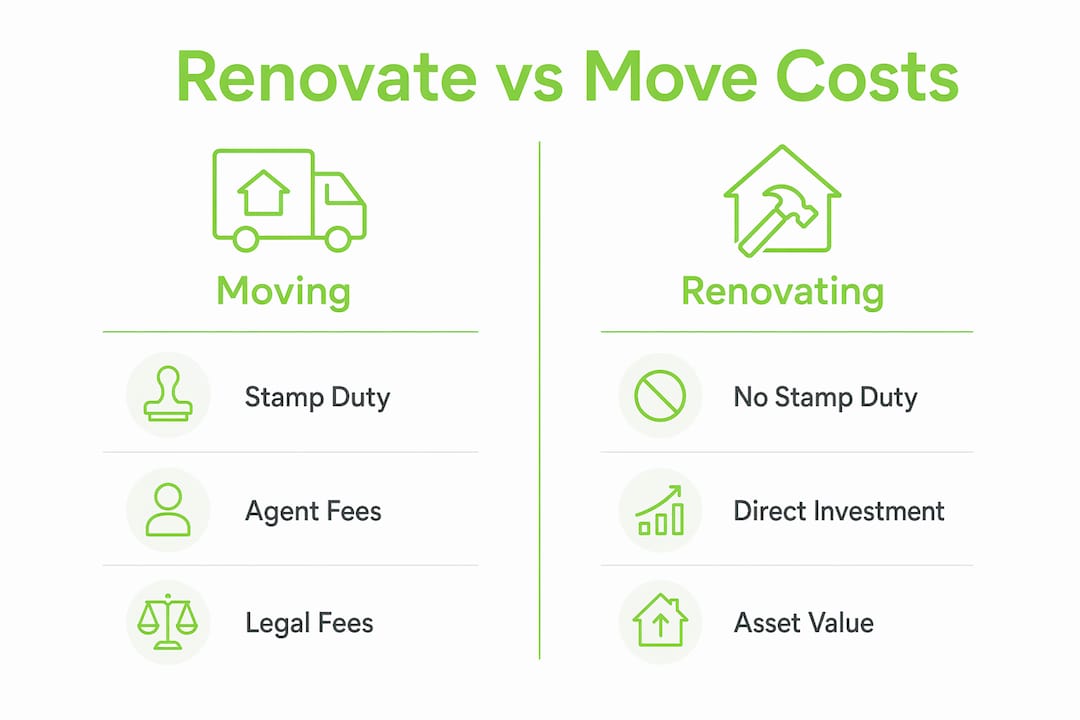
The table makes the comparison concrete. Moving costs are fixed losses. Renovation costs are investments that stay in your home’s value.
Pro Tip: Budget a 15–20% contingency on top of any renovation quote. Hidden issues like outdated wiring or subfloor rot appear regularly once walls open up, and having that buffer keeps your project on track without financial panic.
How do lifestyle and community factors shape the decision?
Money is only part of the picture. School zones, community networks, and commute times play a significant role in the renovation versus relocation decision. These are factors that no spreadsheet fully captures, but they carry real weight in daily life.
Staying in your current home preserves what took years to build. Think about the benefits that are easy to overlook:
School zone security. Your children stay enrolled in the school you chose. Moving even a few suburbs can mean losing that placement entirely.
Community roots. Neighbors, local friendships, and familiar routines provide a sense of stability that a new suburb cannot replicate overnight.
Commute certainty. You know exactly how long your morning takes. Moving can add 30 minutes each way without warning.
Family proximity. If aging parents or close relatives live nearby, relocation creates distance that affects everyday support networks.
Reduced disruption. Renovation is disruptive, but it is temporary and contained. Moving disrupts every aspect of life at once, including work, school, and social routines.
A well-designed renovation improves home functionality, natural light, and thermal comfort rather than simply expanding square footage. That distinction matters. Adding a rear extension with north-facing glazing, for example, can transform a dark Victorian terrace into a home that feels twice its size without changing the address. You keep the suburb you love and gain the living space you need.
There is also an emotional dimension that deserves honest acknowledgment. Homes witness generations. They hold the marks of children growing up, the memory of gatherings, and the comfort of the familiar. Choosing to renovate instead of move honors that continuity while still giving your home room to grow with you.
What risks and challenges come with renovating instead of moving?
Renovation is not without its complications. Homeowners who go in without clear eyes often find the process harder than expected. Construction delays, builder insolvency, and the stress of living through renovations add real costs beyond the quoted price. Understanding these risks upfront is what separates a successful project from a painful one.
The most common renovation pitfalls include:
Budget overruns. Scope creep and hidden defects push costs beyond initial quotes. A kitchen remodel that starts at $60,000 can reach $90,000 once structural issues surface.
Builder reliability. Not all builders manage timelines or communication well. Choosing a builder with a proven track record and transparent project management reduces this risk significantly.
Overcapitalization. Spending more on renovations than the local market can return is a real danger. Avoid spending more than the gap between your unrenovated and renovated home value in your suburb.
Hidden structural defects. Rot, outdated wiring, and subfloor issues appear regularly once renovation work begins. Anticipate these with contingency funds built into your budget.
Living disruption. Major renovations may require temporary accommodation, adding cost and stress to the project timeline.
Pro Tip: Before signing any contract, research comparable sales in your suburb carefully. If renovated homes in your area sell at $850,000 and unrenovated ones at $700,000, your renovation budget ceiling is around $100,000–$120,000 to protect your return on investment.
The 5 reasons to renovate your home are compelling, but they only hold up when the project is planned with discipline. Choosing a builder who manages the full process, from design through to completion, reduces the chance of costly surprises. That end-to-end oversight is exactly what Yorcon provides on every project.
When is moving the smarter choice over renovating?
Renovation is not always the right answer. There are clear situations where relocation makes more sense, and recognizing them honestly is part of good decision-making.
Moving makes sense when a property cannot meet evolving life needs due to structural constraints or location issues that renovation cannot fix. A block too small to extend, a suburb that no longer suits your lifestyle, or a home with irreparable structural damage all point toward relocation.
Market timing risk in moving can cost $50,000 or more when you sell low and buy high in a fluctuating market. That risk cuts both ways. If your current suburb has strong growth prospects and your target suburb is already at its ceiling, staying and renovating captures more long-term value.
Scenario | Renovate | Move |
Love your suburb, need more space | ✓ Strong case | ✗ Costly |
Block too small to extend | ✗ Limited options | ✓ Consider moving |
School zone is critical | ✓ Stay and renovate | ✗ Risk losing zone |
Structural damage beyond repair | ✗ Not viable | ✓ Move or rebuild |
Lifestyle shift to different area | ✗ Renovation won’t help | ✓ Relocation fits |
Suburb at price ceiling | ✗ Risk overcapitalization | ✓ Upgrade suburb |
The knock-down rebuild versus renovate question also belongs in this conversation. When a home’s bones are sound but its layout is fundamentally wrong, a rebuild on the same block can deliver a new home without the cost of buying into a new suburb. That option sits between renovation and full relocation and deserves serious consideration.
Understanding owner-occupied property implications for capital gains tax and stamp duty concessions also affects the financial math. A tax adviser familiar with Victorian property rules can clarify how these factors shift the numbers in your specific situation.
Key Takeaways
Renovating beats moving financially when transaction costs exceed what a well-planned renovation would cost, making it the stronger choice for most Melbourne homeowners who love their suburb.
Point | Details |
Moving costs are sunk costs | Transaction fees of $90,000–$140,000+ return no equity, unlike renovation funds. |
Renovation builds direct value | Even major renovations at $150,000–$300,000 stay in your property’s asset column. |
Lifestyle factors are decisive | School zones, commute, and community ties often outweigh pure financial calculations. |
Overcapitalization is a real risk | Research local comparable sales before setting a renovation budget to protect your ROI. |
Move only when renovation can’t solve it | Structural limits, wrong location, or a price-ceiling suburb are valid reasons to relocate. |
What I’ve learned after nearly two decades of Melbourne renovations
After working on hundreds of Melbourne homes, the pattern I see most often is this: homeowners who move regret the transaction costs within 12 months. They arrive in the new house, realize the layout still doesn’t work for them, and start planning a renovation anyway. They’ve paid $100,000 or more in fees to end up in the same situation.
The homeowners who renovate well, on the other hand, almost always say the same thing afterward. They wish they’d done it sooner. The key word there is “well.” A renovation done without proper planning, a realistic budget, or a builder who communicates clearly can be just as painful as a bad move.
My honest advice is to start with a brutally honest audit of your current home. Can the layout be fixed? Is the block large enough to extend up or out? Is the suburb genuinely right for your next decade of life? If the answers are yes, renovation is almost always the better path. If the suburb no longer fits or the structure is beyond saving, move with clarity and don’t look back.
What I’d caution against is making this decision based on emotion alone in either direction. The homeowner who moves because they’re frustrated with a cramped kitchen is making a $140,000 decision about a $30,000 problem. The homeowner who renovates a structurally compromised home out of attachment is throwing good money after bad. The right call comes from honest numbers and honest self-assessment, ideally with a professional who has seen both outcomes many times.
— Matthew
Yorcon’s approach to renovation in Melbourne
If you’ve worked through the numbers and the lifestyle factors and renovation is the right call, the next step is finding a builder who manages the process with full transparency from day one.

At Yorcon, we specialize in home renovations in Melbourne and home extensions that are designed around how you actually live. With nearly 20 years of experience across heritage terraces, contemporary family homes, and architectural builds, we manage every stage of your project, from design through to completion, so nothing falls through the cracks. Our clients tell us that the transparency and communication we bring to each project is what sets the experience apart. If you’re ready to talk through what’s possible for your home, we’d love to hear from you.
FAQ
How much does it cost to renovate vs move in Melbourne?
Moving in Melbourne typically costs $90,000–$140,000 in transaction fees alone, with lifetime relocation costs potentially reaching $285,000. Renovation costs range from $5,000 for cosmetic updates to over $300,000 for major structural work, and those funds stay in your property’s equity.
Is it better to renovate or move if I need more space?
Renovating is usually the better choice if your block allows an extension and you value your current suburb. A rear extension or second-story addition typically costs far less than the combined transaction fees of selling and buying a larger home.
What are the biggest risks of renovating instead of moving?
The main risks are budget overruns from hidden defects, construction delays, builder reliability issues, and overcapitalization. Building a 15–20% contingency into your budget and researching local comparable sales before you start reduces all of these risks significantly.
When does moving make more financial sense than renovating?
Moving makes more sense when your property has structural issues renovation cannot fix, your block is too small to extend, or your suburb has reached its price ceiling and spending more on renovation would not return value.
Does renovation add more value than moving to a new home?
Renovation adds value directly to your existing asset without triggering stamp duty or agent fees. Moving forces you to repurchase at full market price, including all associated taxes and commissions, which means you start the new property at a financial deficit from day one.
Recommended


