
Melbourne Builder Explains Progress Payment Schedules for Homeowners


A progress payment schedule sets out when your builder gets paid as work moves through defined construction stages, and the rule that matters most is simple: you only pay for work that’s finished and inspected, never in advance. In Victoria, the Domestic Building Contracts Act 1995 anchors this principle, and Yorcon builds every contract around it.
TL;DR:
In Victoria, the deposit is capped at 5% once the contract price hits $20,000 — not a 5–10% range.
The Domestic Building Contracts Act 1995 sets maximum percentages for each stage. They’re ceilings, not suggestions, and overclaiming carries penalties.
Base and frame claims should be backed by your building surveyor’s inspection approval. Lock-up and fixing have no mandatory surveyor inspection, so those stages rest entirely on how your contract defines them.
Security of payment legislation and adjudication don’t apply to home builds in Victoria. Domestic building disputes go to DBDRV conciliation, then VCAT.
Overpaying isn’t covered by Domestic Building Insurance. If you’ve paid for work that was never done, that gap is your loss.
Table of Contents
What does the law require for progress payments in Australia?
Deposit caps exist for a reason. Most residential building contracts cap the initial deposit, and Victoria’s Domestic Building Contracts Act 1995 sets out under section 40 exactly how much a builder can claim at each defined stage, with penalties for anyone who overclaims.
Victoria is more prescriptive than most states. Any domestic building work over $10,000 requires a written major domestic building contract, and the Domestic Building Contracts Regulations set maximum percentages a builder can claim at each stage. You and your builder aren’t free to invent a schedule — the ceiling is fixed by regulation.
Here’s what that generally looks like in practice:
In Victoria, the deposit cap is set by section 11 of the Domestic Building Contracts Act 1995: 5% where the contract price is $20,000 or more, and 10% where it’s under $20,000. On a $700,000 extension, that means no more than $35,000 up front. A builder asking for 10% of a major contract is asking for something the Act doesn’t allow.
Progress claims must be tied to a completed stage, not a calendar date or a builder’s cash flow needs.
Parties can agree to a different schedule structure, but VCAT can order a refund where a builder has claimed more than the work justifies.
Pro Tip: Ask your builder for the exact percentage breakdown before you sign, not after the first invoice lands. A schedule agreed in writing upfront is far easier to enforce than one you’re trying to reconstruct mid-build.
What are the standard stages in a residential building contract?
Victoria names its stages in legislation rather than leaving them to industry convention: base, frame, lock-up, fixing and completion. Knowing what “complete” actually means at each point is what stops you from paying for a stage that’s only partly done.
Base/slab: footings and slab poured, or subfloor structure finished.
Frame: wall and roof framing erected and, in most cases, passed frame inspection.
Lock-up: external walls, windows, doors and roof covering installed, so the building is weatherproof.
Fixing: kitchen, bathroom fixtures, doors, skirting and cabinetry installed.
Completion: the home is finished and habitable, bar minor defects.
The maximum a builder can claim at each stage:
Stage | Maximum % of contract price (Vic) |
Deposit | 5% (10% if under $20,000) |
Base/slab | 10% |
Frame | 15% |
Lock-up | 35% |
Fixing | 25% |
Completion | 10% |
Unlike most states, these aren’t indicative figures — they’re ceilings, and a builder who overclaims at a stage faces penalties under the Act. What still needs checking is proportionality within the ceiling: 35% at lock-up is lawful, but only once the building is genuinely weatherproof.
How do payment disputes actually work in Victoria?
You’ll see references online to “payment claims,” “payment schedules” and adjudication under security of payment legislation. Those don’t apply to you. Victoria’s Building and Construction Industry Security of Payment Act 2002 specifically excludes domestic building contracts with an owner who lives, or intends to live, in the home. That regime is for commercial contracts and subcontractor chains.
For a home build or renovation in Melbourne, the path is different:
Raise the dispute with your builder in writing first, stating exactly which stage you say isn’t complete and why.
If that doesn’t resolve it, apply to Domestic Building Dispute Resolution Victoria (DBDRV). This is free, and conciliation through DBDRV is generally a required step before you can take a domestic building dispute to VCAT.
DBDRV can issue a binding dispute resolution order, including orders about money owed or work to be rectified.
VCAT is the next step if conciliation fails or DBDRV issues a certificate saying the matter isn’t suitable for conciliation.
The practical upshot is more forgiving than the commercial regime: you don’t lose your right to dispute a claim by missing a short statutory window. But you do need your objection in writing, with evidence, and you need it early.
What should you check before releasing any payment?
Victoria’s mandatory inspection points are set by your building surveyor and typically cover footings, reinforcement before the concrete pour, the completed frame, and final inspection. Base and frame stage claims should be backed by the surveyor’s approval at those points. Lock-up and fixing have no mandatory surveyor inspection, so for those stages you’re relying on the contract’s own definition of what’s complete — which is exactly why those definitions need to be specific before you sign.
For base and frame, ask for the surveyor’s inspection approval. For lock-up and fixing, ask for dated photographs against the contract’s stage description, item by item.
Ask for dated photos and supplier invoices for prime-cost items like tiles or appliances.
Bring in an independent building inspector if you have any doubt about progress.
Share your payment schedule with your lender early, since financiers often run their own stage valuations that can differ from the builder’s claim.
Overpaying also erodes the protection you get from Domestic Building Insurance, which is required in Victoria on domestic building contracts over $16,000 and is arranged through the VMIA. DBI is last-resort cover: it responds if your builder dies, disappears or becomes insolvent, and it pays toward completing or rectifying the work. It does not refund you for work you paid for but never received. If you’ve paid 60% and only 40% is built, that 20% gap is your loss, not the insurer’s.
What can you do if a builder demands payment outside the agreed schedule?
Getting an unexpected invoice, or a demand for money before a stage is finished, is unsettling. Here’s the order of operations that protects your position.
Don’t pay on the spot. Check the claim against your contract’s defined stages and the work actually completed on site.
Put your objection in writing straight away — which stage you say isn’t complete, what’s missing, and what you’re withholding. There’s no statutory deadline on you in a domestic contract, but a contemporaneous written record is what a conciliator will look for later.
Keep every piece of evidence: photos, inspection reports, emails and the original contract.
If the dispute doesn’t resolve directly, apply to Domestic Building Dispute Resolution Victoria for free conciliation. Since 2017, DBDRV, not Consumer Affairs Victoria, handles domestic building disputes between owners and builders.
Escalate to VCAT only after DBDRV conciliation has run its course, or DBDRV certifies the matter unsuitable for conciliation.
A few things trip homeowners up here:
A verbal objection is legally valid but practically useless. Without a written record naming the stage and the reason, you’re arguing from memory a year later.
Withholding without evidence is its own risk. A conciliator can find the stage was complete and order you to pay, plus interest under the contract.
Don’t let a disputed claim sit. DBDRV conciliation works best while the work is still on site and inspectable.
How do you negotiate a fair payment schedule before you sign?
A payment schedule is really a risk-sharing tool, not just an admin formality, and getting it right before signing saves both parties from disputes later. In Victoria, the final 10% payment at completion is your retention — it’s the leverage that gets the defects list closed out. Don’t release it against a promise.
Get the completion stage defined precisely — occupancy permit or certificate of final inspection issued, defects list agreed and closed out. That final 10% is your only real leverage, so make sure the contract says exactly what has to happen before it’s payable.
Fixed-price contracts generally give you more certainty on progress amounts than cost-plus arrangements, which can shift as costs change.
Watch for red flags: unusually large upfront requests, vague stage descriptions like “general progress,” or a builder unwilling to use a standard HIA or Master Builders Victoria contract.
Clear stage definitions in the contract itself, not left to interpretation on site, are what actually prevent arguments six months in.
Yorcon’s approach to progress payment schedules
We structure every Yorcon contract around clearly defined stages, independent inspections, and direct liaison with your lender before the first payment is due. That means no ambiguity about what “lock-up” or “fixing” actually means on your project, and no invoice that arrives without evidence behind it. Our building process guide walks through exactly how stages and milestones are defined in a typical contract.
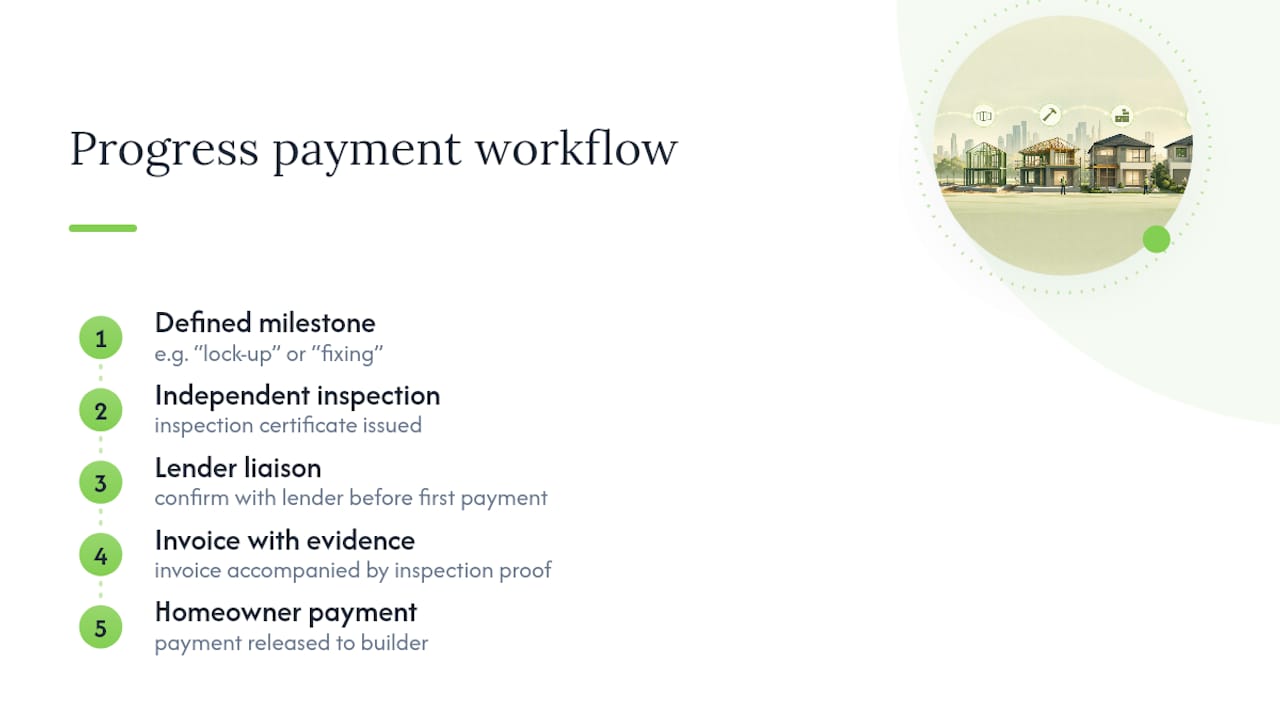
Nearly two decades of building across Melbourne has taught us that transparent invoicing, backed by inspection certificates, is what keeps a renovation or new build free of payment disputes. It’s not complicated. It just has to be done properly, every time.
How Yorcon can help you plan your build with confidence
If you’re weighing up a home extension, a full renovation, or a new architectural build in Melbourne, the payment schedule is one of the first things worth getting right, and it’s exactly where Yorcon’s fixed-price, fully managed contracts give you an edge over piecing a project together yourself. We handle design, permits, inspections and progress claims as one connected process, so you’re never left guessing whether an invoice matches the work on site.
Our home extensions and design-and-build services both come with a transparent, stage-by-stage payment structure agreed before work starts, along with independent inspections at every claim point. If you’re restoring a period property, our heritage renovation team applies the same protections to more complex, character-driven builds. Get in touch for a fixed-price quote and we’ll walk you through exactly how your progress payment schedule will work, stage by stage, before you sign anything.
The one rule that protects you more than any clause
Every homeowner we’ve watched navigate a build eventually learns the same lesson: contracts don’t protect you; enforcement does. You can have the most carefully worded payment schedule in Australia and still get burned if you release funds before an inspection has actually passed. That’s the gap between what a good contract promises and what actually keeps your money safe.
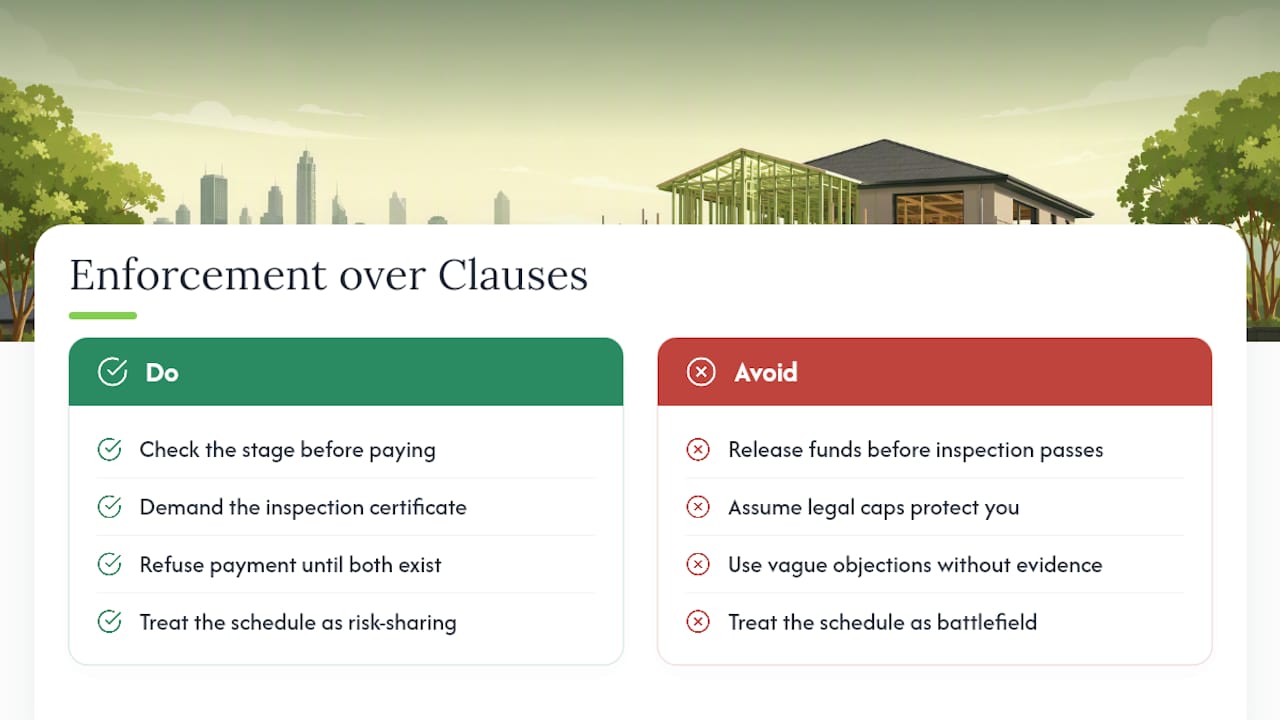
Where we think most homeowners get it wrong is assuming the legal caps under the Domestic Building Contracts Act do the protecting for them. They don’t. Those caps set a ceiling on what a builder can ask for, but nothing stops a builder from asking for that ceiling before the work justifies it. The only thing standing between you and an overclaim is your own discipline in checking the stage, demanding the certificate, and refusing to pay until both exist.
DBDRV conciliation cuts both ways. It’s not a homeowner’s weapon — a conciliator can just as easily find that you’ve withheld payment on a stage that was in fact complete, and order you to pay. Vague “stage not complete” objections without evidence don’t survive contact with a conciliator.
Sources
Recommended


