
Melbourne Architect Fees: Expect 8–15%. ARBV Rules and Builder Tips

For most Melbourne residential projects, expect an architect fee commonly within a range around 8–15% of the cost of works for a full-service engagement, with smaller advisory jobs charged hourly or as a fixed fee. Heritage overlays, tricky sites, and council approvals push that figure higher. Before you sign anything, ask for a written Client‑Architect Agreement and regular statements of account.
TL;DR:
Most Melbourne architects charge between 8-15% of the construction cost for full-service projects, with higher fees for heritage or complex sites.
Fees are paid in stages aligned with project milestones, from concept design to site inspections, each with specific deliverables and payment percentages.
The standard hourly rate averages around $180, and fees increase with heritage requirements, restricted sites, or extensive interior details.
Clients must have a signed Client-Architect Agreement before any fees are charged, detailing scope, fee basis, and disbursements.
Comparing quotes requires asking about fee structures, included services, disbursements, scope changes, and checking ARBV registration for transparency.
Table of Contents
How do architects charge for fees in Melbourne?
Most Melbourne architects use one of three billing structures, and knowing which one you’re being quoted under is the first step to comparing proposals properly.
Percentage of Cost of Works is the most common model for full-service residential projects. The architect’s fee scales with your build cost, typically landing in that 8–15% band depending on project complexity and service level. It rewards architects for delivering a design that performs on budget, although it can create tension if you want extensive design exploration without the cost of works growing to match.
Lump-sum or fixed fees suit clearly defined scopes, like a plans-only package for a straightforward extension or a heritage-compliant facade study. You know the number upfront, which is reassuring, but only if the scope is nailed down tightly, because anything outside it gets billed as a variation.
Time-based (hourly) rates work well for consultations, feasibility studies, or small advisory jobs where the scope is genuinely open-ended.
A few things to clarify before you sign anything:
Whether the percentage applies to Cost of Works inclusive or exclusive of GST
Whether quoted fees are GST-inclusive (mandatory for consumer clients under ARBV rules)
Which services sit inside the fee, and which are billed separately
How do architect fees map to project stages?
Architects don’t invoice the full fee upfront. It’s released against milestones as the project moves through distinct phases, and each stage buys you specific deliverables.
Concept design (roughly 15–20% of total fee): initial sketches, spatial planning, and a design direction you sign off on before anything gets detailed.
Design development (around 20–25%): refined drawings, material selections, and enough detail to firm up a realistic cost estimate.
Town planning or permit lodgement (10–15%, where required): documentation and liaison for Development Approval or planning permit applications, often the slowest and most unpredictable stage in Melbourne’s heritage suburbs.
Construction documentation (25–30%): the detailed drawings a builder actually prices and builds from, including structural and services coordination.
Tender and contract (5–10%): comparing builder quotes and helping you land on a contract.
Construction phase / site inspections (15–20%): periodic site visits to check the build matches the drawings, and to answer the inevitable questions that come up mid-build.
Milestone invoicing is usually scheduled at the end of each stage, not on a fixed monthly basis, which is one reason project delays can bunch up your payment schedule unexpectedly.
What are typical architect fees and dollar examples in Melbourne?
Percentages only mean something once you attach them to real numbers, so here’s how they typically play out.
Small consultation or feasibility advice: often $2,000–$10,000 as a fixed fee, or $100–$250 per hour for one-off advice on a renovation you’re still scoping.
Plans-only package (no construction-phase involvement): frequently priced as a lump sum, reflecting drawings and permit documentation without ongoing site oversight.
Full-service renovation or extension on a $300,000 build: at 10–12%, that’s roughly $30,000–$36,000 across all stages.
Full-service new build on a $600,000 build: the same percentage band produces $48,000–$90,000, which is exactly why two homes with similar-looking briefs can carry very different architect fees.
Complex or heritage project: percentages often sit at the upper end (13–15%+) because of additional consultants, heritage reporting, and extended council liaison.
Victorian hourly averages run around $180 per hour, a touch above some other capitals, which reflects Melbourne’s density of heritage stock and more involved planning pathways. If you want a clearer picture of how these percentages sit against actual Melbourne construction costs, it’s worth reading before you fix a budget number in your head.
What pushes architect fees higher in Melbourne?
Several factors reliably shift a quote toward the top of the range, and most of them are worth budgeting a contingency for rather than being surprised by later.
Heritage overlays and heritage-listed properties demand extra reporting, council negotiation, and sometimes a heritage consultant, all of which add time. Our heritage renovation cost guide breaks down why these projects run higher across the board, not just on architect fees.
Bushfire Attack Level (BAL) or flood-prone sites trigger additional engineering and compliance work.
Restricted site access (narrow laneways, tight inner-suburban blocks) often means more coordination with structural engineers and surveyors.
High-end interior fitout detail or specialist consultants (landscape, lighting, joinery designers) add scope beyond the base architectural service.
Change orders mid-project are one of the biggest quiet cost drivers. Every scope change should trigger a documented fee adjustment, not a vague verbal agreement.
Developers running multiple lots often negotiate different terms than owner-occupiers, since repeat business and standardised documentation can justify a lower percentage.
What must a Client‑Architect Agreement include in Victoria?
A fee proposal is not a contract. Under ARBV’s Code of Professional Conduct, a signed Client‑Architect Agreement (CAA) must be in place before an architect provides services or charges fees, and the proposed agreement should be given to you at least 7 business days before signature so you actually have time to read it.
Pro Tip: Don’t pay a deposit until the CAA lands in your inbox. If an architect is pushing you to pay before you’ve seen the agreement, that’s a signal to slow down.
Insist on these in writing:
The fee basis stated precisely (percentage, lump sum, or hourly), and whether it’s calculated on Cost of Works inclusive or exclusive of GST
Regular, itemised statements of account, which ARBV guidance treats as standard practice, not an optional extra
A schedule of included and excluded services, since the CAA2024 template treats anything ambiguous as excluded by default
Records must be kept for 10 years under Clause 6, which matters if a dispute ever surfaces years after practical completion.
What questions should you ask when comparing architect quotes?
Ten questions get you a genuinely comparable set of proposals, rather than three numbers that look similar but cover wildly different scope:
What’s the fee basis, and is it percentage, lump sum, or hourly?
Is the percentage calculated on Cost of Works including or excluding GST?
What services are explicitly included, and what’s excluded?
How are milestone payments scheduled and invoiced?
What disbursements (printing, travel, statutory fees) should I expect on top?
Are consultant fees (structural, services, heritage) included or separate?
How are scope changes documented and priced?
What professional indemnity insurance do you carry?
Who retains intellectual property and copyright over the drawings?
Are you currently registered with the ARBV, and can I check that listing myself?
Red flags: no written CAA offered, a vague fee basis with no percentage or rate stated, or a quote silent on disbursements. Choosing purely on the lowest number is often a false economy, since site supervision and approvals are exactly the services that get quietly dropped to win the job.
A builder’s perspective on architect fees in Melbourne
From the construction side, an architect’s fee is rarely the whole story. Poorly coordinated design and documentation is where hidden costs creep in, through site variations, clashing trades, and finishes that don’t match what was priced. We’ve found that projects with tight architect-builder coordination from the outset, whether through an architectural build service or a design-and-build arrangement, run smoother because fewer decisions get made on the fly during construction.
A final word on architect fees
Get the Client‑Architect Agreement in writing, insist on regular milestone invoices, and don’t sign a fee proposal you haven’t sat with for a few days. Before committing, request three comparable quotes, confirm ARBV registration yourself, and check exactly which services are included.
— Matthew
Where to verify architect fee rules and benchmarks
For the regulatory detail, ARBV’s Code of Professional Conduct sets out the transparency obligations every registered Victorian architect must follow, and the Client‑Architect Agreement guideline covers the 7-day review rule in full.
For market benchmarks, the hipages cost breakdown and Bark’s national analysis both give useful percentage and hourly rate comparisons across Australian cities.
To confirm a practitioner is currently registered before you sign anything, use ARBV’s find-an-architect service directly rather than relying on a business card or website claim.
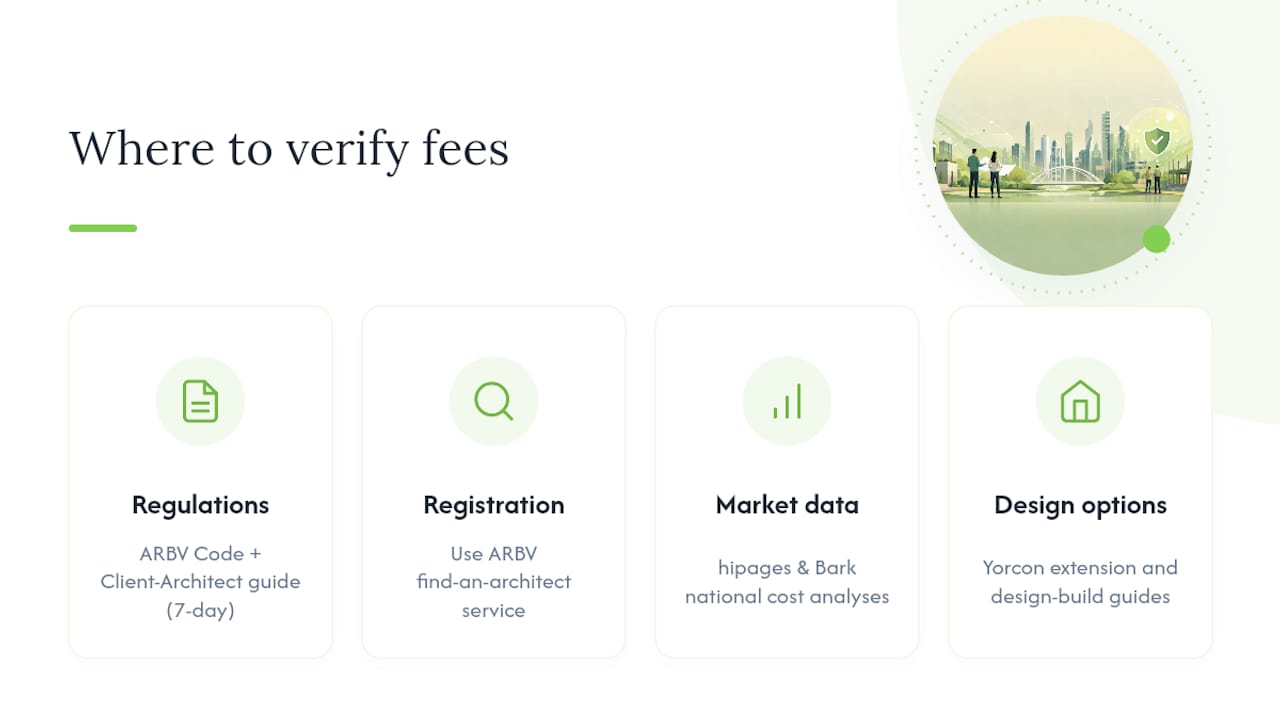
If you’re weighing up an architect-led design against an integrated build approach, Yorcon’s home extension budget guide and design and build service are worth a look before you finalise your fee structure.
Sources
Recommended


