
Practical Completion vs Handover: What Owners Need to Know

Updated: Aug 17

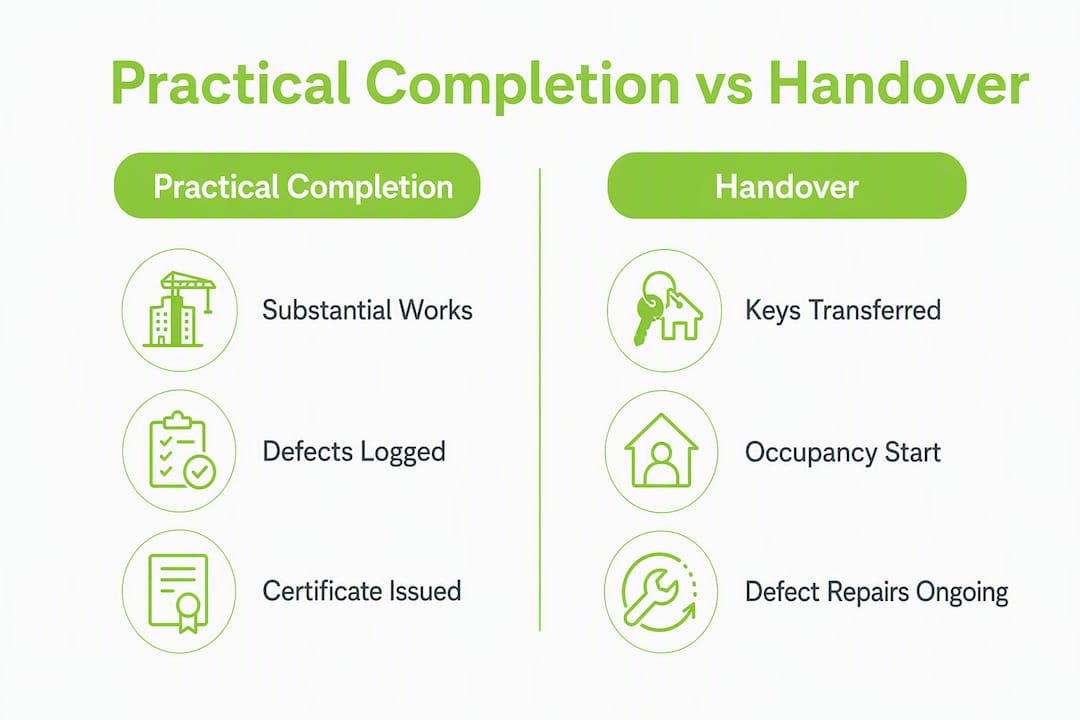
Practical completion is the contractual milestone confirming your home is substantially complete and fit for occupation; handover is the separate act of transferring possession, keys, documents, and insurance risk to you once final payment and required paperwork are satisfied.
Here is what each milestone actually changes:
Practical completion starts the defects liability period (DLP), typically 12 months under most standard contracts, and triggers the release of part of any retention held.
Handover transfers physical possession and insurance risk from builder to owner, usually once the final account is paid.
Liquidated damages (if applicable) stop accruing at practical completion, not at handover.
Final completion is a third, later milestone — it follows after all defects are rectified and the DLP ends, releasing any remaining retention.
Understanding the sequence matters because your leverage to compel fixes is strongest before the Certificate of Practical Completion is signed, not after keys change hands.
Table of Contents
What does practical completion mean under an Australian building contract?
Practical completion marks the point where building works are substantially complete and reasonably fit for their intended use, even if minor defects remain. That “substantially complete” threshold is the key phrase. It does not mean a perfect, defect-free finish. It means the home functions as a normal home: it has power and water, it is weatherproof, and you can move in.

Under standard residential contracts in Australia, including HIA (Housing Industry Association) forms and AS-series contracts, practical completion is typically confirmed by a notice or certificate issued by the builder, superintendent, or a certifying authority depending on your contract type. The certificate triggers several immediate contractual consequences: the defects liability period begins, liquidated damages cease, and a portion of any retention held is usually released to the builder.
What counts as a minor defect at practical completion?
Minor defects permitted at practical completion typically include painting touch-ups, minor tile grout inconsistencies, and small finish omissions. What prevents practical completion is more significant: a missing oven that was specified in the contract, no electrical supply to the property, or structural work left incomplete. The line between “minor” and “major” is drawn by whether the defect prevents the home from being fit for its intended use.
Why the practical completion inspection matters
Pro Tip: Conduct your practical completion inspection (PCI) before signing any certificate or paying the final account. Once you sign, minor defects shift from contract completion conditions into the slower warranty process.
The PCI is your single most powerful moment in the entire build. Defects recorded in the Certificate of Practical Completion are contractually binding on the builder to fix. Defects discovered after handover become warranty claims, which are slower and more formal to enforce. Schedule your PCI with enough time to review the builder’s notice, engage an independent inspector if needed, and document every item in writing before you put pen to paper.
What actually happens on handover day?
Handover is the act of transfer. Once practical completion is confirmed and the final account is paid, the builder hands over physical possession: the keys, the access codes, the documentation pack, and, critically, the insurance risk. From that moment, the home is your responsibility to insure and maintain.
The typical sequence on handover day, as outlined by the HIA, runs like this:
Builder issues notice of anticipated practical completion (commonly 2–3 weeks in advance).
Owner and builder conduct a joint practical completion inspection.
Defects are recorded in writing.
Final account is issued and payment made.
Certificate of Practical Completion is signed.
Keys, documents, and possession transfer to the owner.
One thing handover does not always include: every item on your defect list being fixed before you receive the keys. Outstanding minor defects carry over into the DLP. What you must have before handover is a written record of those defects, signed by both parties, so the builder’s obligation to rectify them is clear and enforceable.
Builder notice periods for handover vary by contract, so check your specific HIA or AS contract clause. Owners generally have a defined period to respond to a practical completion notice, attend the inspection, and make final payment. Missing those windows can have contractual consequences, so read your contract carefully before the final stages begin.

How is practical completion different from final completion?
These two milestones are often conflated, but they operate at opposite ends of the defects liability period. Practical completion is the starting gun; final completion is the finish line.
Final completion occurs when all defects recorded at practical completion have been rectified, all contractual paperwork and warranties are in order, and the builder’s obligations under the contract are fully discharged. Under most standard contracts, this happens at or near the end of the DLP, which is commonly 12 months after practical completion.
The financial consequences of the distinction are real. Under many standard contracts, retention is typically released in two tranches: roughly 50% at practical completion and the balance at final completion. Liquidated damages stop at practical completion. Warranty claims become the primary remedy after practical completion, with statutory warranties under state legislation providing a longer backstop.
Milestone | When it occurs | Key financial/legal trigger |
Practical completion | Works substantially complete, fit for use | DLP starts; liquidated damages end; first retention tranche released |
Handover | Final payment made, keys transferred | Possession and insurance risk transfer to owner |
Final completion | All defects rectified, DLP ends | Remaining retention released; contractual obligations discharged |
A concrete example: imagine a heritage renovation where the builder reaches practical completion with a few paint touch-ups and a minor joinery adjustment outstanding. You move in, the DLP runs, those items are rectified over the following weeks. Final completion is only achieved once every agreed item is done and the builder formally notifies you that all obligations are discharged. Until then, the retention balance sits with you as financial leverage.
Always read your contract’s specific definitions. As Sprintlaw notes, those contract clauses determine exactly when warranties and retention release operate — and they vary between HIA forms, AS 4000, and bespoke contracts.
Who inspects and certifies practical completion?
The practical completion inspection (PCI) and the handover walk-through are not the same thing, and treating them as interchangeable is where many owners lose leverage.
Under standard residential contracts, the PCI is conducted before the Certificate of Practical Completion is issued. The builder, the owner, and sometimes a superintendent or private certifier attend. The certifier’s role varies by state: in Queensland, the QBCC provides guidance on inspection rights and statutory warranties; in Victoria, the Victorian Building Authority (VBA) oversees compliance; in New South Wales, the NSW Fair Trading framework applies.
A handover inspection, by contrast, typically happens at or after key transfer. GoInspect’s guidance makes the distinction clear: a PCI creates stronger leverage to compel fixes before the certificate is issued, while a handover inspection has weaker enforceability because the contractual completion conditions have already been met.
What to demand from an independent inspector’s report
Pro Tip: Ask your inspector to assign each defect to a trade (e.g., “tiling — grout inconsistency, bathroom 2”), include a photograph with a timestamp, and rate each item as minor or major. That format maps directly onto the Certificate of Practical Completion and removes ambiguity about what the builder must fix.
Independent inspectors such as those operating under the AllInspect network provide written reports structured for exactly this purpose. A good report does not just list problems; it gives you a defensible, trade-assigned defect schedule you can attach to the certificate. That specificity matters if a dispute arises later.
What documents should you receive at handover?
The QBCC confirms that at handover, homeowners should expect a Certificate of Occupancy or Final Inspection Certificate, appliance manuals, and warranties for specialised products used in the build. That is the baseline. A thorough handover pack covers considerably more.
Document | Why it matters | What to check |
Certificate of Occupancy / Final Inspection Certificate | Confirms the building is legally approved for occupation | Matches your property address and approved plans |
Plumbing compliance certificate | Confirms plumbing work meets the National Construction Code | Issued by a licensed plumber; check it covers all new work |
Electrical compliance certificate | Confirms electrical installation is safe and code-compliant | Covers all circuits installed during the build |
Structural warranty / builder’s warranty | Provides recourse for structural defects beyond the DLP | Note the warranty period and the warranting entity |
Appliance manuals and product warranties | Needed for warranty claims on installed appliances | Check expiry dates and registration requirements |
Final account and receipts | Confirms all payments and variations are reconciled | Verify all variations are itemised and agreed |
Certificate of Practical Completion | The contractual record of the completion milestone | Confirm defect schedule is attached and signed by both parties |
If any document is missing at handover, request it in writing immediately. Insurance policies for newly completed homes often require a Certificate of Occupancy before cover activates, so a missing certificate is not a minor administrative gap. For an overview of the building process and the paperwork produced at each stage, Yorcon’s guide walks through the full sequence from permit to handover.
A practical checklist for your inspection walk-through
The practical completion inspection is not a casual walk-through. Approach it methodically, room by room, and document everything in writing before you leave the site.
Room-by-room items to check
Doors and windows: Open and close every door and window. Check for smooth operation, correct alignment, and functioning locks and hardware.
Flooring: Look for lippage in tiles, gaps in timber flooring, and any damage to floor coverings. Check transitions between rooms.
Tiling and wet areas: Inspect grout lines, silicone seals around baths and showers, and waterproofing membrane edges. Run water to check drainage.
Fixtures and fittings: Test every tap, showerhead, toilet flush, and exhaust fan. Check that all specified fixtures match the contract schedule.
Appliances: Run every appliance through at least one cycle. Check that rangehoods vent correctly and that dishwashers drain properly.
Hot water system: Confirm it is operational and that the temperature relief valve is installed.
Electrical: Test every power point, light switch, and circuit breaker. Confirm smoke alarms are installed and operational.
Ventilation: Check that all exhaust fans vent to the exterior, not into the roof cavity.
External drainage: Walk the perimeter and check that stormwater drains away from the building.
Paintwork: Look for runs, holidays (missed patches), and inconsistent sheen levels in natural light.
How to document defects properly
Write each defect as: location / trade / description / severity. For example: “Master bathroom / tiling / grout inconsistency on north wall, approximately 600mm run / minor.” Photograph each item with your phone’s timestamp visible. Keep a numbered list so each defect has a reference number that can be carried into the Certificate of Practical Completion.
Do not use vague language like “general finish issues.” Specific, trade-assigned entries are enforceable. Vague entries are not. For more guidance on questions to ask your builder before and during the inspection process, Yorcon’s checklist covers the conversations that protect your interests.
How do payments, retention, and possession connect?
The financial sequence at practical completion and handover is tightly linked, and understanding it prevents costly mistakes.
The typical sequence runs: builder issues notice of anticipated practical completion → owner conducts PCI → defects recorded → final account issued → final payment made → Certificate of Practical Completion signed → keys and possession transferred.
Stage | Financial event | Risk/possession |
Practical completion notice issued | Final account prepared | Builder retains possession |
PCI completed, defects recorded | Final payment triggered | Builder retains possession |
Final payment received | First retention tranche released (typically ~50%) | Possession transfers to owner |
DLP ends, all defects rectified | Remaining retention released | Owner holds full possession |
Under many standard contracts, the HIA is clear that the final payment is required with no right to deduct for minor defects. Withholding final payment because you are unhappy with a paint touch-up can delay handover and keep the builder legally in possession of your home. That is not a position most owners want to be in. The correct approach is to record the defect formally, pay the final account, take possession, and hold the builder to the DLP process for rectification.
Insurance risk transfers at handover, coinciding with the payment and possession transfer. From the moment keys change hands, your home insurance must be active. Confirm your policy start date aligns with the handover date, not the practical completion date.
Procore’s guidance on practical completion notes that missing notices, conditional certificates, or incomplete documentation cause most practical completion disputes. Follow the contract sequence precisely: notices in writing, certificates signed by the right parties, and payment made within the contractual timeframe.
Common mistakes owners make and how to avoid them
Most practical completion disputes are avoidable. They tend to stem from a handful of predictable errors.
What not to do:
Do not sign the Certificate of Practical Completion without conducting a thorough PCI first. Once signed, your leverage to compel pre-completion fixes is gone.
Do not treat a casual walk-through with the builder as a formal PCI. An informal inspection has no contractual weight.
Do not assume all documents will arrive without asking. Request your full handover pack in writing before the handover date.
Do not withhold final payment for minor defects. Under most standard contracts, this is not permitted and can backfire legally.
Do not skip independent inspection. Builder-only inspections miss items that an independent eye catches.
What to do instead:
Schedule an independent PCI before the certificate is issued. Providers like those in the AllInspect network offer pre-handover inspection services specifically structured for this purpose.
Insist on written certificates for all compliance items (electrical, plumbing, structural) before handover.
Record every defect in the Certificate of Practical Completion with trade assignment and photographic evidence.
Follow up all verbal rectification commitments with written requests, referencing the defect number from your inspection report.
Know your statutory warranty rights. In Queensland, the QBCC administers statutory home warranty insurance and dispute pathways. Similar bodies operate in each state. These are genuine last resorts, though — securing fixes before handover is always faster and less stressful than a formal dispute process.
The HIA’s practical completion guidance reinforces a point that owners often miss: practical completion exists precisely to allow occupation while minor cosmetic items are completed under the defects liability regime. It is not a failure of the process when minor items remain. The failure is when those items are not documented before the certificate is signed.
Key Takeaways
Practical completion starts the defects liability period and transfers financial risk; handover transfers physical possession and insurance responsibility once final payment is made.
Point | Details |
Practical completion vs handover | Practical completion is the contractual milestone; handover is the physical transfer of keys, documents, and insurance risk. |
Defects liability period | The DLP (commonly 12 months) starts at practical completion, not at handover. |
Retention release | Retention is typically released in two tranches: roughly 50% at practical completion, the balance at final completion. |
PCI timing | Conduct your practical completion inspection before signing any certificate — this is your strongest point of leverage. |
Yorcon’s approach | Yorcon manages the full closeout sequence, from coordinated PCI to final handover pack, so owners reach handover with documentation complete and defects formally recorded. |
Why the handover process deserves more respect than it gets
The practical completion and handover sequence is where a build either finishes well or unravels. We have seen both outcomes, and the difference almost always comes down to preparation and documentation rather than the severity of the defects themselves.
There is a tendency among homeowners to treat the final stages as a formality — the hard work is done, the house looks finished, and the excitement of moving in overrides the discipline of a thorough inspection. That instinct is understandable. It is also expensive. A defect that costs a few hundred dollars to fix before the certificate is signed can cost multiples of that to pursue through warranty processes six months later, not because the builder is unwilling, but because the formal warranty pathway is slower, more adversarial, and harder to enforce without a clear written record.
What we find works consistently well is treating the PCI as a structured, trade-by-trade review rather than a general walk-through. When defects are assigned to trades, photographed, and numbered, the rectification process is efficient. The builder knows exactly what is expected, the owner has a clear record, and the DLP becomes a straightforward follow-up process rather than a source of ongoing tension.
The other thing worth saying plainly: a reputable builder welcomes a thorough PCI. It protects both parties. If your builder is resistant to an independent inspection or pressures you to sign the certificate before you are satisfied with the inspection, that resistance is itself useful information about how the DLP is likely to go.
Yorcon guides you through practical completion and handover
For homeowners building or renovating in Melbourne, the closeout stages of a project deserve the same attention as the design and construction phases. At Yorcon, we coordinate the full practical completion and handover process: a structured PCI, a complete handover pack covering all certificates, manuals, warranties, and compliance documents, final account reconciliation, and follow-through on defect rectification throughout the DLP.

With nearly 20 years of residential construction experience across home extensions, renovations, architectural builds, and heritage restorations in Melbourne, we know that a well-managed handover is not just good practice. It is what protects your investment and gives you confidence from day one of occupation. If you are approaching the final stages of a build or renovation and want to know what a professionally managed handover looks like, explore Yorcon’s home renovation services or get in touch to discuss your project.
Useful sources and further reading
The following sources provide authoritative guidance on practical completion, handover, and inspection rights for Australian homeowners:
QBCC: Handover and final documentation — Queensland Building and Construction Commission guidance on the documents owners should receive at handover, including certificates, manuals, and warranties.
QBCC: Handover overview — Explains what “suitable for occupation” means and what the property must include before practical completion is confirmed.
HIA: Practical completion guidance — Housing Industry Association explanation of the practical completion process, notice periods, and final payment obligations under standard HIA contracts.
Procore: Practical completion in construction — Covers the DLP, retention mechanics, and how contract sequence failures cause disputes.
Prosper Law: What is practical completion? — Legal explanation of the substantially complete threshold and the distinction between practical and final completion.
Sprintlaw: Practical completion vs final completion — Explains how contract definitions determine when warranties and retention release operate.
Lynch Meyer: Practical completion and handover — Legal update on permissible minor defects and the risk of confusing practical completion with a defect-free finish.
VBA: Victorian Building Authority — Victorian regulator for building compliance, inspection rights, and practitioner licensing.
NSW Government: Building and construction — NSW framework for building approvals, inspections, and owner rights at completion.
Recommended


