
Hold Payment, Builder View: New Home Handover Checklist Australia


Book your pre-handover inspection 3 to 7 days before handover or settlement, but not the morning of. Withhold your final payment until you have the occupation certificate and the waterproofing, electrical and plumbing compliance certificates in hand, or a written record of agreed defects. Photograph every issue, put it in a dated snag list, and send it to your builder before a single dollar changes hands.
TL;DR:
Conduct the pre-handover inspection 3 to 7 days before settlement to allow time for repairs and ensure compliance certificates are available.
Verify waterproofing, electrical, and plumbing certificates, and photograph every defect to document issues clearly for potential warranty claims.
Test all systems, including doors, windows, appliances, and drainage, and bring necessary inspection tools like a torch and level to ensure thorough assessments.
Collect key certificates and manuals, such as the occupation certificate, energy compliance, and warranties, which are essential for proving the home meets standards and for future claims.
Use the inspection as leverage to negotiate repairs, ensuring all defect notices are in writing and involve independent assessments for structural or waterproofing concerns.
Table of Contents
New home handover checklist Australia: the room-by-room walkthrough
Which documents and certificates should you collect at handover?
When should you schedule your inspection and when do you withhold payment?
How do you report defects and what are your warranty rights?
What should you bring to the inspection, and what tests actually matter?
What happens after handover: follow-ups and the 90-day check?
A builder’s perspective: what nearly 20 years in Melbourne has taught us
Why the standard advice on handover checklists misses the point
New home handover checklist Australia: the room-by-room walkthrough
A handover inspection isn’t a stroll through your new lounge room admiring the paint colour. It’s a methodical hunt for the small failures that turn into expensive headaches once you’ve moved the furniture in and the builder has moved on to the next job. We’ve walked hundreds of Melbourne homes through this exact process, and the properties that cause the fewest post-handover dramas are the ones where buyers checked everything, not just what caught their eye.
Work through the property in a logical order, starting outside and finishing with the systems that hide behind walls and under floors.
Exterior and siteworks
Check roof tiles and flashings for cracks, lifted tiles, or gaps where a valley meets a wall.
Run your eye along the gutters for correct pitch, secure brackets, and downpipes that actually connect to stormwater rather than dumping onto the ground.
Look at site drainage, particularly where the block slopes towards the house rather than away from it.
Inspect cladding, render, and external paint for consistency, and walk the paths and driveway for cracking or pooling.
Interior finishes
Check plaster and cornices for cracking, especially around door frames and window openings where movement shows first.
Look at paint finish under natural light, not just under downlights, since roller marks and patchy coverage hide in artificial light.
Run a hand along skirting boards and architraves for gaps, and check floor finishes for scratches, lippage in tiles, or squeaky boards.
Open and close every door and window. They should latch cleanly, seal properly, and not drag on the frame.
Wet areas
Ask for waterproofing certificates before you inspect the bathrooms, because waterproofing failures are among the most expensive and common defects in new Australian builds, and once the tiles go down, proving a membrane fault gets costly fast.
Check shower and bath falls drain water towards the outlet, not towards the door or a corner.
Look at tiling for consistent grout lines, no hollow-sounding tiles, and properly sealed silicone joints and flashings around taps and hobs.
Kitchen
Open every cupboard and drawer to check alignment and smooth runners.
Run a level across the benchtop, since a lean of even a few millimetres shows up quickly once you put glassware on it.
Check the splashback finish and confirm every appliance is installed, connected, and powers on.
Electrical and mechanical systems
Test every light switch and power point, and trip the safety switches (RCDs) to confirm they cut power immediately.
Run the hot water system, check the air conditioning or heating cycles properly, and confirm exhaust fans and smoke alarms are wired and working, not just screwed to the ceiling.
Garage and external inclusions
Test garage remotes and confirm you’ve received every key, fob, and manual promised in the contract.
Walk the landscaping and any pool equipment against your inclusions list, checking nothing was substituted or left out.
Pro Tip: Bring a torch even during daylight hours. Roof cavities, under-sink cabinetry, and garage corners are exactly where builders hope you won’t look closely, and a torch turns a guess into a confirmed fact.
Which documents and certificates should you collect at handover?
The paperwork matters as much as the paint job. Without the right certificates, you have no way to prove the home meets Australian building standards, and no leverage if something fails down the track.
At minimum, insist on:
The occupation certificate (sometimes called the practical completion certificate), which confirms the building surveyor considers the home suitable for occupation and that final inspections have checked compliance with the National Construction Code.
Waterproofing certificates for every wet area, bathroom, laundry, and any balcony or external tiled surface.
Electrical compliance certificates confirming the wiring meets AS/NZS 3000, and plumbing compliance certificates for the water and drainage work.
As-built plans showing exactly what was constructed, which matters enormously if you ever renovate or extend.
Appliance manuals and warranties for everything installed, from the oven to the hot water system.
A termite protection certificate, since most Australian states require one and it protects your structural warranty.
Energy efficiency and NCC compliance documentation, particularly relevant if you’re claiming any energy rebate down the line.
Keep every one of these documents together, physically or digitally, because you’ll need them if you ever lodge a warranty claim or sell the property. QBCC guidance is explicit that handover should include certificates and a defects document, and that “suitable for occupation” is a defined standard, not a builder’s opinion.
When should you schedule your inspection and when do you withhold payment?
Timing changes everything about how useful your inspection actually is. Inspect too early and unfinished work looks like a defect. Inspect too late and you’ve got no time to fix anything before settlement.
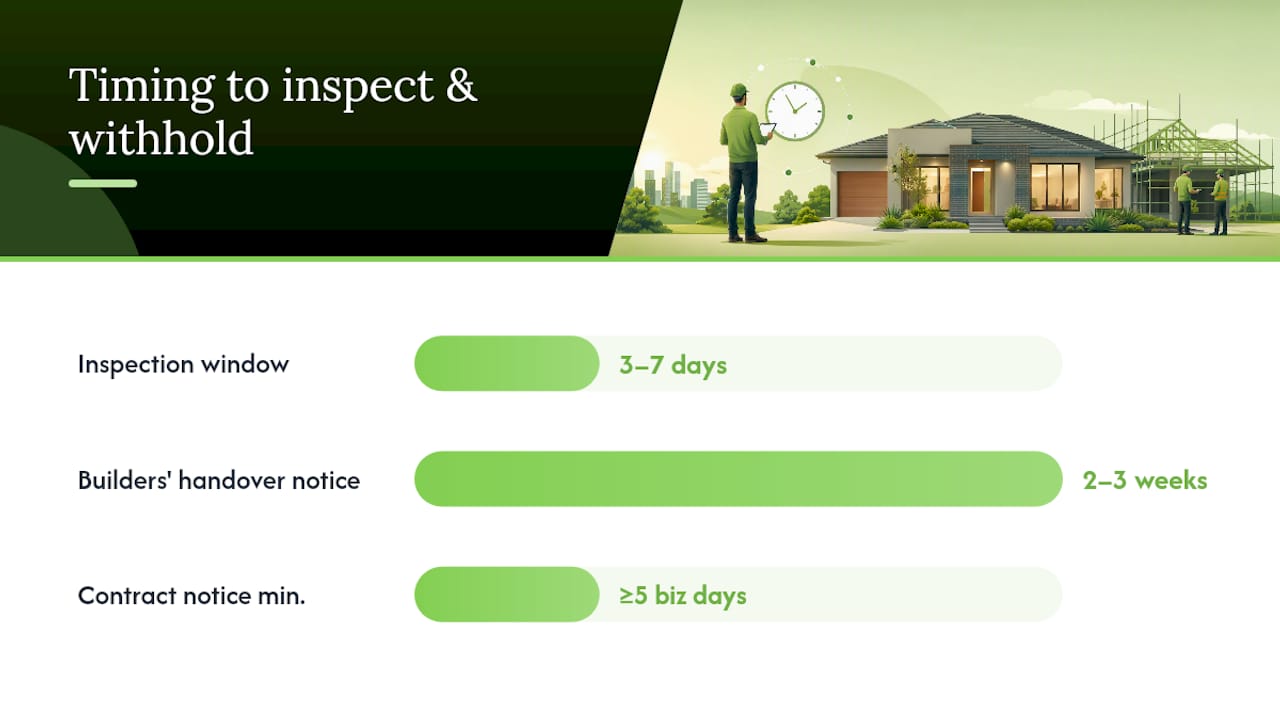
The window that works best is 3 to 7 days before handover or settlement. Consumer Affairs Victoria recommends inspecting within the week before settlement and bringing your contract and inclusion list along, and CommBank’s own guidance to buyers points to the same 3 to 7 day window, specifically because it gives you time to arrange repairs or renegotiate before funds move.
A few practical rules make this window work:
Builders typically issue handover notices 2 to 3 weeks ahead, with many contracts requiring at least 5 business days’ notice before practical completion.
Talk to your lender and conveyancer before you release final funds. They need to know if defects are outstanding, because it affects when settlement can legally proceed.
Use your written inspection report as leverage. Most building contracts allow you to negotiate rectification work or a retention amount held back until repairs are done.
Never verbally agree to “fix it later” without getting the promise in writing, dated, and specific about what will be fixed and by when.
If the occupation certificate hasn’t been issued, or the compliance certificates aren’t ready, that’s a legitimate reason to hold your final payment. Our guide on practical completion versus handover breaks down exactly what separates these two milestones and why the distinction protects your money.
How do you report defects and what are your warranty rights?
The clock on your statutory warranty period generally starts at practical completion, not the day you move your furniture in. That’s exactly why documenting every defect at your pre-handover inspection matters. It locks in your claim rights from day one, rather than leaving you to argue later about when a problem actually appeared.
Warranty periods and reporting rules vary by state, but the underlying principle is consistent: under QBCC guidance, contractors must repair defects noted at handover or within 12 months of the work being finished, and owners should notify the contractor of any defect within 12 months of first noticing it. Our full breakdown of defects liability periods across Australian states covers how Victoria, New South Wales, and Queensland differ on specifics.
To make a defect claim that actually gets action:
Photograph every issue with a timestamp, and note the room and the specific defect.
Write a dated snag list assigning each defect to the relevant trade, tiler, electrician, plasterer.
Keep every email and text exchange with your builder about the fix. Verbal promises disappear; written ones don’t.
If the builder doesn’t rectify within the agreed timeframe, escalate to your state authority, the QBCC in Queensland, the Victorian Building Authority in Victoria, or NSW Fair Trading in New South Wales, and loop in your conveyancer.
For anything structural or related to waterproofing, get an independent building inspector to assess it before you accept the builder’s own explanation.
Pro Tip: Assigning each defect to a specific trade in your written report, rather than a vague “bathroom issue”, makes it far harder for a builder to argue the problem isn’t theirs to fix. Specificity is your best protection.
What should you bring to the inspection, and what tests actually matter?
Pack light but pack smart. Bring your building contract, your inclusion list, your phone or camera, a torch, a roll of masking tape for flagging issues, a power point tester, a spirit level, and a notebook.
Then work through a simple test sequence:
Run the hot water system and check temperature and pressure.
Flush every toilet and check the cistern refills properly.
Test every single power point and light switch, not just a sample.
Turn on every appliance that’s meant to be connected and powered.
Check every tap for flow, temperature control, and leaks underneath.
Check drains for slow water movement, which often signals a blockage or poor grading.
Photograph everything as you go, label each photo with the room and the specific test, and transfer the lot into your written snag list before you leave the property. RealEstateCalc’s buyer guidance makes the same point: document problems immediately, don’t rely on memory once you’re back home comparing notes with your partner.
What happens after handover: follow-ups and the 90-day check?
Handover isn’t the finish line. Schedule a follow-up inspection at 90 days and again at the 12-month mark, and photograph anything that’s changed, cracks that have widened, doors that now stick, silicone that’s started to lift.
Get written timelines for any agreed rectification work, and get written confirmation once it’s actually done. Start your home and contents insurance from the handover date itself, not from your planned move-in date, since a gap in cover is a gap you’re personally exposed to. Keep every certificate, manual, warranty, and defect email in one place. You’ll need the full set if you ever lodge a warranty claim years down the track.
A builder’s perspective: what nearly 20 years in Melbourne has taught us
We coordinate practical completion tightly, matching every certificate and sign-off to a documented handover pack before handing over keys. The snag items we see most often are minor, cupboard alignment, silicone finishing, paint touch ups, and they get resolved fastest when owners raise them specifically, with photos and room references, rather than a general sense that “something feels off”. Clear documentation is what keeps handover cooperative rather than combative.

Why the standard advice on handover checklists misses the point
Most checklists treat handover as a box-ticking exercise: walk the rooms, note the scuffs, sign the form. That undersells what’s actually happening. Handover is the moment your legal position is strongest and your leverage is highest, because the builder still wants their final payment and still has crews on-site who can fix things quickly.
Where generic advice falls short is timing and paperwork. Plenty of guides tell you to “check for defects” without explaining that the warranty clock starts at practical completion, meaning a defect you fail to document today can become a dispute about dates in twelve months’ time. The paperwork isn’t bureaucratic box-checking. It’s the entire basis of any claim you’ll ever need to make.
If you take one thing from this article, make it this: prioritise the certificates before you prioritise the cosmetics. A scratched benchtop gets fixed with a phone call. A missing waterproofing certificate can cost you thousands to prove after the tiles are down.
— Matthew
Let Yorcon manage your build and handover from day one
Yorcon is the alternative to piecing together your own build oversight in Melbourne: instead of chasing certificates, coordinating trades, and managing your own defects list at the eleventh hour, you get one team managing the entire process from design through to a documented handover. Every project runs through our end-to-end project management approach, covering permits, approvals, and construction oversight, with clear communication at each stage so handover day isn’t the first time you’re seeing paperwork.

Whether you’re planning a new luxury home, a knockdown rebuild, or a full design and build project, you can expect a documented handover pack, proactive snag management, and a team that keeps you informed rather than guessing at where your build stands. If you’re at the early planning stage, our architectural house design service starts from $15,000 to $35,000, one-off, depending on scope. Book a free project feasibility call with our team to talk through your project and what a Yorcon handover would look like for your home.
Where to check compliance rules and book an inspection
For state-specific defect and complaint pathways, consult the QBCC or your relevant state authority. For pool compliance, Local Pool Inspections handles same-day Form 23 assessments in Geelong.
Sources
FAQ
What should I include on my home handover checklist?
Your checklist should cover exterior siteworks, interior finishes, wet area waterproofing, kitchen fittings, and every electrical and mechanical system, alongside collecting the occupation certificate and all compliance certificates. Test every power point, tap, and appliance rather than sampling a few, and document everything with photos before you sign off.
How do I pass a home inspection checklist?
There’s no “passing” a self-inspection since it’s your protection, not a test you sit. The goal is thorough documentation: photograph every issue, assign it to a trade, and get it in writing before making your final payment, which is what actually protects you if problems surface later.
How clean does my house need to be for an inspection?
Builder cleans vary, but the property should be swept of construction debris and dust before your pre-handover inspection so you can actually see finishes clearly. It doesn’t need to be spotless. Grime hiding a genuine defect, like a crack disguised by dust, is worth flagging regardless.
Does a house have to be empty for a pre-settlement inspection?
Yes, for a new build handover, the property should be empty of the previous occupant’s belongings and free of trades still working, so you can inspect every surface, switch, and fitting without obstruction. Consumer Affairs Victoria recommends inspecting within the week before settlement for exactly this reason, when the property is finished but funds haven’t yet changed hands.
Recommended


