
Domestic Building Insurance Victoria: What You Need to Know


If your Victorian building project is valued above the applicable legal threshold for domestic building insurance, your builder is legally required to hold domestic building insurance before taking a deposit. Here are the three things to do right now:
Ask your builder for the Notice of Cover and a copy of the policy (plus a certificate of currency) before you hand over any money.
Verify the Notice of Cover by contacting the Building and Plumbing Commission (BPC) directly through their portal or phone line.
Do not pay a deposit until you have sighted a valid certificate of currency with your property address and the correct contract value.
The three bodies you will deal with most are the Building and Plumbing Commission (BPC), which issues the Notice of Cover and manages the Home Warranty framework; Consumer Affairs Victoria, which sets out builder obligations and homeowner rights; and Domestic Building Dispute Resolution Victoria (DBDRV), your first port of call if a dispute arises.
Key Takeaways
Domestic building insurance in Victoria is a mandatory, legally enforceable protection for homeowners, and the 1 July 2026 transition to Home Warranty changes both the threshold and the verification process.
Point | Details |
Threshold and trigger | DBI required for contracts over $16,000 before 1 July 2026; Home Warranty applies at $20,000 for major contracts signed on or after that date. |
Coverage limits | Up to $300,000 for structural defects (6 years) and non-structural defects (2 years) when a builder is insolvent, dead, or has disappeared. |
Verification step | Always request the Notice of Cover from the BPC and the certificate of currency before paying a deposit. |
Dispute escalation | Workmanship disputes go to DBDRV first, then VCAT; statutory implied warranties under the Domestic Building Contracts Act 1995 apply for up to 10 years. |
Yorcon’s approach | Yorcon manages insurance compliance and documentation as part of full-service project delivery across Melbourne extensions, renovations, and new builds. |
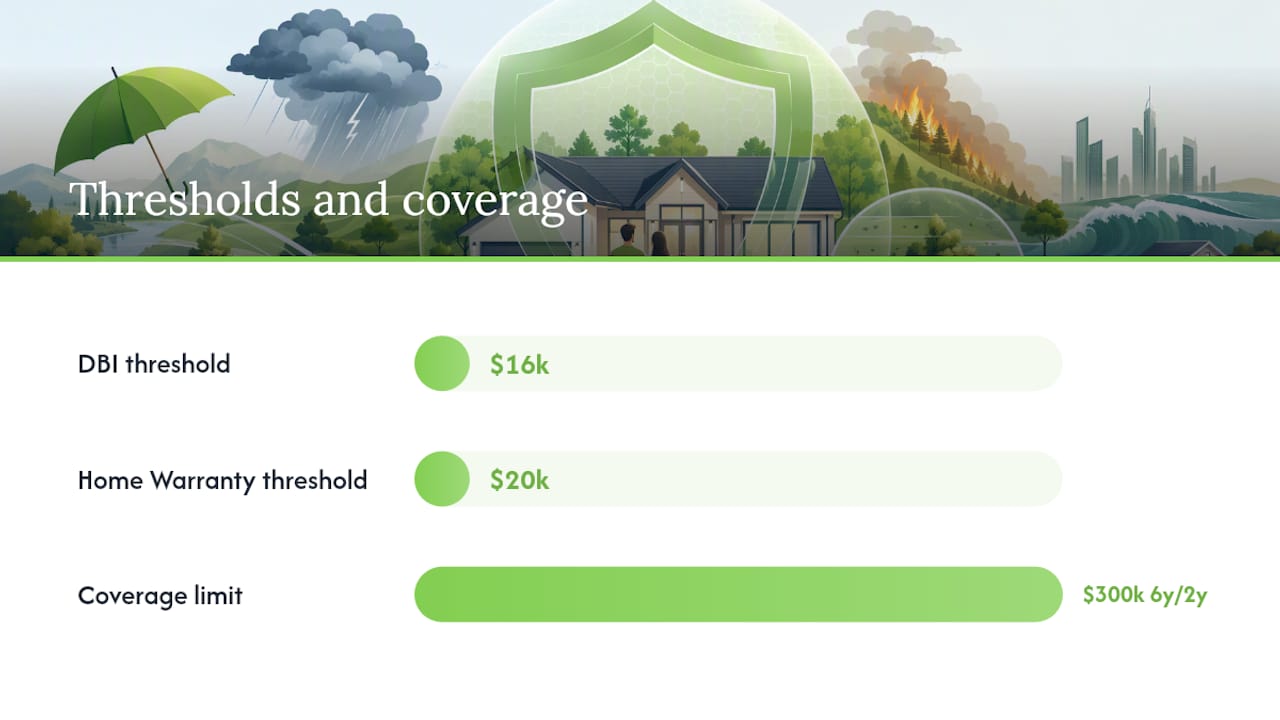
Table of Contents
What domestic building insurance in Victoria actually covers
Domestic Building Insurance (DBI) is the state-regulated protection that sits behind every eligible residential building contract in Victoria. At its core, it protects you as a homeowner if your builder cannot complete the work or fix defects because they have become insolvent, died, or disappeared. From 1 July 2026, this cover transitions to the Home Warranty framework, but the fundamental protection remains the same.
It is worth being clear about what DBI and Home Warranty are not. They are not the same as contract works insurance, which covers physical damage to a project under construction (fire, storm, theft). They are also not public liability insurance, which covers third-party injury or property damage. DBI and Home Warranty are specifically triggered by the builder’s inability to perform, not by site accidents or general workmanship disputes.
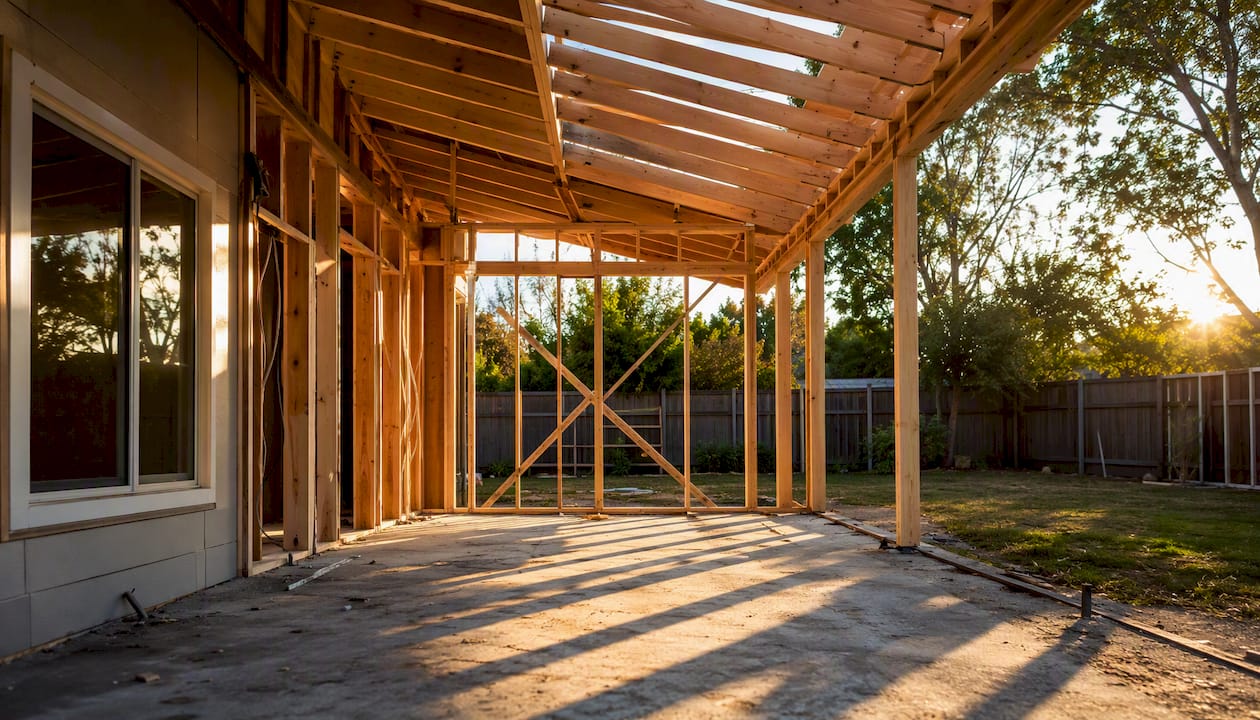
A practical example: you sign a $180,000 contract for a rear extension in Melbourne’s inner north. Work begins, the builder completes the frame and roof, then enters voluntary administration. You are left with an incomplete structure and no builder. Because your builder held a valid DBI policy, you can lodge a claim with the insurer to recover the cost of completing the work, up to the policy’s monetary limits.
Who must hold this insurance and what the thresholds are
The obligation to hold domestic building insurance sits with the registered builder, not the homeowner. Under VBA guidance, DBI is required for domestic building work where the contract value exceeds a specified legal threshold for contracts entered into before 1 July 2026.
From 1 July 2026, the Home Warranty framework applies to major domestic building contracts signed on or after that date, with the threshold rising to a specified legally set amount for homes of up to three storeys of accommodation.
Key eligibility rules to know:
Major domestic building contracts (as defined under the Domestic Building Contracts Act 1995) trigger the insurance obligation. Registered tradespeople must use a major domestic building contract when the work value exceeds $10,000.
Multi-storey exemption: Buildings with more than three storeys of accommodation are generally exempt. Be aware that ancillary spaces such as foyers and storage areas can count as accommodation and change a building’s classification, so check with the BPC if your project is borderline.
Owner-builders have separate obligations. If you are an owner-builder and you sell the property within six years of the occupancy permit being issued, you must take out a policy to protect the buyer. The certificate must be provided to the buyer before settlement.
The builder must provide you with a copy of the policy and a certificate of currency before taking any deposit. This is a legal requirement, not a courtesy.
The documents that prove eligibility and coverage are the Notice of Cover (issued by the BPC under the Home Warranty framework), the Letter of Eligibility (LOE) (which the insurer issues to the builder and which must be no more than 12 months old), and the certificate of currency.
What the cover actually pays out and for how long
Consumer Affairs Victoria sets out the coverage limits clearly. DBI and Home Warranty provide coverage within legal monetary limits for structural defects, with timeframes defined by the type of defect.
A few important limits and exclusions to understand:
Insured events are specific. Cover is triggered by the builder’s insolvency, death, or disappearance. For policies issued after 2015, non-compliance with a VCAT or court order can also trigger a claim in limited circumstances.
General workmanship disputes are not covered by DBI or Home Warranty. If your builder is still trading but doing poor work, the insurance does not apply. Your remedy is through DBDRV and VCAT using the statutory implied warranties under the Domestic Building Contracts Act 1995.
Incomplete works claims may be limited to a proportion of the contract price rather than the full outstanding amount, depending on how far the work had progressed.
Normal wear and tear and post-completion defects that fall outside the insured events are excluded.
Pro Tip: Track two separate clocks from the date of your occupancy permit: the DBI/Home Warranty policy timeframes (6 years structural, 2 years non-structural) and the 10-year statutory limitation period for building defects. As Justice Connect explains, the statutory limitation period is separate from the insurance cover period, meaning you may still have legal remedies through DBDRV and VCAT after the insurance has expired.
How to verify coverage before you sign or pay anything
Verification is a short process, but skipping it is one of the most common mistakes homeowners make. Here is the sequence to follow:
Request the Notice of Cover and certificate of currency from your builder before signing anything or paying a deposit. The certificate must show your property address, the contract value, the insurer’s name, and the policy number.
Contact the BPC to confirm the Notice of Cover is genuine. You can do this through the BPC portal or by calling them directly. Do not rely solely on a document the builder hands you.
Ask for the Letter of Eligibility (LOE) if you want to confirm the builder’s eligibility to obtain insurance. The LOE must be dated no more than 12 months before the policy was issued.
Check the insurer. The Victorian Managed Insurance Authority (VMIA) has historically been a significant provider of domestic building insurance in Victoria, alongside commercial insurers. Confirm the issuing insurer is a recognised provider.
Questions worth asking your builder directly:
“Can you show me the Notice of Cover issued by the BPC?”
“Who is the insurer and what is the policy number?”
“What events are covered and what are the monetary limits?”
“Is this project covered under the Home Warranty framework or the older DBI framework, and what is the contract date?”
Pro Tip: Red flags on a certificate of currency include: no BPC Notice of Cover attached, a policy issue date more than 12 months old without a current LOE, and a property address that does not match your project site. Any mismatch is a reason to pause and contact the BPC before proceeding.
If you do not receive proof of insurance, delay any deposit payment and contact the BPC immediately. If the builder refuses to provide documentation, note the date and escalate to Consumer Affairs Victoria or DBDRV.
How to make a claim and what to do when disputes arise
When a builder becomes insolvent, dies, or disappears mid-project, the process moves quickly. Here is the sequence:
Notify the builder (or their administrator/estate) in writing that you are aware of the situation and intend to make a claim.
Gather your documentation: the signed contract, the certificate of currency, the Notice of Cover, all correspondence with the builder, invoices paid to date, and photos of the work completed.
Lodge a claim with the insurer or contact the BPC for direction on the correct lodgement process under the Home Warranty framework.
Submit supporting evidence: inspection reports from an independent building inspector, photos, invoices for remediation quotes, and a timeline of events.
Track your timeframes. Claims for incomplete works and defects must be lodged within the policy’s coverage periods (6 years for structural, 2 years for non-structural from completion).
For disputes about workmanship where the builder is still trading, the insurance does not apply. The escalation path is:
DBDRV first. Domestic Building Dispute Resolution Victoria handles most workmanship and contract disputes before they reach a tribunal. This is a mandatory step in most cases.
VCAT next. If DBDRV cannot resolve the dispute, the Victorian Civil and Administrative Tribunal hears the matter. At VCAT, the statutory implied warranties under the Domestic Building Contracts Act 1995 become the primary remedy, not the insurance policy.
Consumer Affairs Victoria is an information and referral point throughout the process.
Legal advice is worth seeking before VCAT if the dispute involves a significant sum or complex defects.
Common reasons claims are denied include: the policy was not in force at the time of the insured event, the defect falls outside the insured events (e.g., the builder is still trading), the claim was lodged outside the coverage period, or the defect is specifically excluded under the policy terms. Keeping thorough records from day one is the single best way to reduce this risk.
Who pays for the insurance and how it appears in your contract
Builders arrange and pay for DBI and Home Warranty. The cost is almost always built into the contract price or itemised as a separate insurance charge on the contract schedule. Check your contract carefully for:
Who arranges the policy (it must be the registered builder, not the homeowner).
Whether the premium is included in the contract price or charged as a separate line item.
The policy details (insurer name, policy number, coverage period) referenced in the contract.
For owner-builders selling within six years of the occupancy permit, the obligation shifts. You must arrange and pay for a policy that protects the buyer, and the certificate must be provided before settlement. This is a separate obligation from the builder’s insurance and applies even if no registered builder was involved in the original construction.
Key dates: the move to Home Warranty from 1 July 2026
The transition from DBI to Home Warranty is the most significant change to Victoria’s residential building insurance framework in years. Here is what the timeline means in practice:
Before 1 July 2026: DBI applies to domestic building work over $16,000. The insurer issues the policy directly, and the builder provides the certificate of currency to the homeowner.
From 1 July 2026: Home Warranty applies to major domestic building contracts signed on or after that date, for homes up to three storeys. The threshold rises to $20,000. The BPC issues the Notice of Cover after the contract is signed, replacing the older certificate-only process.
Contracts straddling the transition: If you signed a contract before 1 July 2026 but work continues after that date, the older DBI framework applies. Check the contract date, not the construction start date.
Pro Tip: If work started before the transition or your contract predates 1 July 2026, ask your builder to confirm the policy date and the issuing insurer. Contact the BPC to verify whether a Notice of Cover has been issued or whether the older DBI certificate remains the operative document for your project.
Under the Home Warranty framework, the Notice of Cover issued by the BPC is the definitive document confirming your project is covered. Do not accept a certificate of currency alone for contracts signed on or after 1 July 2026 without also sighting the BPC Notice of Cover.
What reputable builders do to stay compliant
Compliance with domestic building insurance obligations is not just a legal requirement. It is a mark of how a builder manages the entire project. Here is what you should expect from a reputable, registered builder:
Present the Notice of Cover before requesting a deposit for contracts under the Home Warranty framework, or the certificate of currency under the older DBI regime.
Maintain a current Letter of Eligibility (no more than 12 months old) with their insurer, so they can obtain cover for new projects without delay.
Enrol projects in BPC and VMIA portals as required and keep documentation current throughout the build.
Document all communications with the homeowner in writing, including variations, delays, and defect notifications.
Provide a defects inspection report on completion, particularly for owner-builders who may need to sell within six years.
Integrate insurance compliance into project management: permits, inspections, and warranty handover should all be coordinated as part of a single, transparent process.
A builder who hesitates to provide insurance documentation or who cannot name their insurer is a genuine concern. Cross-referencing a builder’s registration and insurance status through the BPC, Consumer Affairs Victoria, and VMIA takes minutes and can save years of dispute. The building process for Australian homes involves multiple compliance checkpoints, and insurance is one of the earliest and most critical.
An honest perspective on why this matters more than most homeowners realise
Most homeowners treat domestic building insurance as a box to tick before the real work begins. That is understandable. When you are excited about a new extension or a major renovation, the last thing you want to think about is what happens if your builder disappears. But the insurance framework is not just a safety net for worst-case scenarios. It is a signal about the builder’s professional standing.

A builder who cannot produce a valid Notice of Cover or certificate of currency is either not registered, not eligible for insurance, or not organised enough to have arranged it. Any of those three possibilities should give you pause. The verification step with the BPC takes a phone call. Skipping it because you trust the builder or because the paperwork feels like a formality is the kind of shortcut that leads to VCAT hearings and years of stress.
The 1 July 2026 transition to the Home Warranty framework is also a genuine opportunity to reset expectations. The BPC’s central role in issuing the Notice of Cover creates a cleaner, more verifiable record than the older certificate-only process. Use it. Ask for the Notice of Cover by name, check it against the BPC portal, and keep a copy with your contract. That single habit protects you more reliably than any amount of goodwill between you and your builder.
Yorcon handles compliance so you can focus on the build
At Yorcon, insurance compliance and project documentation are part of how we manage every build, not an afterthought. With nearly 20 years of residential construction experience across Melbourne, we handle the full project lifecycle, from design and permits through to construction oversight and warranty handover. Whether you are planning a home extension or a knockdown rebuild, we coordinate the insurance obligations, contract documentation, and BPC requirements as part of our standard process.
That said, we always encourage our clients to request the Notice of Cover independently and verify it directly with the BPC before paying any deposit. That step belongs to you, and no builder, including us, should ask you to skip it. If you would like to talk through how we manage compliance on a specific project, get in touch with the Yorcon team for a straightforward conversation about your build.
Sources
This article is general information, not a substitute for advice from a qualified lawyer. Consult a qualified legal professional about your own circumstances before acting on anything here.
Recommended


