
Australia's Defects Liability Period: A Guide for Homeowners and Builders

Updated: Aug 17

The defects liability period (DLP) is the contractual window after practical completion during which your builder must return to site and fix defects at their own cost. For most Australian residential projects, that window is 12 months, though contracts can set it anywhere from 6 to 24 months depending on project complexity. A few things to know right away.
The DLP is a contractual term, not a statutory right. It exists because your contract says it does, so check the exact dates and notice requirements in your agreement.
You must notify defects in writing during the period to preserve your remedies. Verbal complaints rarely hold up.
The DLP expiring does not end the builder’s liability. Statutory warranties and limitation periods under state law can give you recourse for years afterward.
Keep a dated defect log from day one of handover. That single habit protects you whether you are a homeowner in Melbourne, a developer in Brisbane, or a builder managing your own post-construction obligations.
Key Takeaways
The defects liability period in Australia is a contractual window, typically 12 months for residential projects, during which the builder must fix defects at their own cost, but statutory warranties and limitation periods extend your legal recourse well beyond it.
Point | Details |
DLP starts at practical completion | The clock begins on the date of the practical completion certificate, not when you move in. |
Typical residential duration is 12 months | Contracts can set 6–24 months; specialist elements like waterproofing may carry separate warranty periods. |
Written notice is mandatory | Notify defects in writing during the DLP and keep proof of delivery to preserve your contractual rights. |
Statutory warranties survive DLP expiry | Acts like the Domestic Building Contracts Act 1995 (VIC) and Home Building Act 1989 (NSW) provide recourse for latent defects long after the DLP ends. |
Yorcon manages DLPs transparently | Scheduled inspections, a shared defect log, and proactive communication are standard practice on every Yorcon project. |
This article is general information, not a substitute for advice from a qualified lawyer. Consult a qualified legal professional about your own circumstances before acting on anything here.
Table of Contents
What does the defects liability period actually cover?
The DLP covers defects in workmanship, materials, and incomplete items that become apparent after practical completion. Think cracked render that appears six weeks after handover, a door that won’t latch properly, or waterproofing that fails in the first winter rains. These are the kinds of issues the DLP was designed to address.
What is typically included:
Patent defects (visible on reasonable inspection) discovered after the practical completion date
Failures in workmanship or materials that do not meet the contract’s specified standard
Incomplete items that were not apparent at the time of the practical completion inspection
Items expressly listed in the contract as subject to the DLP
What is generally excluded:
Fair wear and tear from normal use
Damage caused by the owner’s misuse or alterations
Defects that were known and accepted at practical completion (these should have been fixed before handover, not deferred)
Manufacturer warranty items, unless the contract expressly brings them within the DLP
One clause worth reading carefully is the restart-on-rectification provision. Under many Australian contracts, and as Builders Academy notes, rectification work during the DLP can trigger a fresh liability period for that specific item. A leaking roof fixed in month three may carry its own new DLP from the repair date, extending the builder’s exposure on that element well beyond the headline expiry.
The superintendent plays a key role here. They typically receive defect notices, direct the contractor to rectify, and confirm when items are closed out. If your contract includes a superintendent, copy them on every written notice.
How long does a DLP usually run in Australia?
Most residential projects in Australia use a 12-month DLP, but the range is wider than many owners realise. According to Procore AU, typical durations run from 6 to 24 months, with 12 months as the residential industry standard. Consumer Affairs Victoria notes that domestic contracts sometimes set shorter periods for smaller works.
Project type | Typical DLP length | Notes |
Residential new build | 12 months | Industry standard; check your specific contract |
Home extension or renovation | 3–12 months | Shorter periods common for smaller scopes |
Commercial building | 12 months | Standard-form contracts (AS 4000, AS 4902) commonly use 12 months |
Government or large-scale project | 24 months | |
Specialist elements (waterproofing, plant, equipment) | Separate warranty period | May exceed the headline DLP |
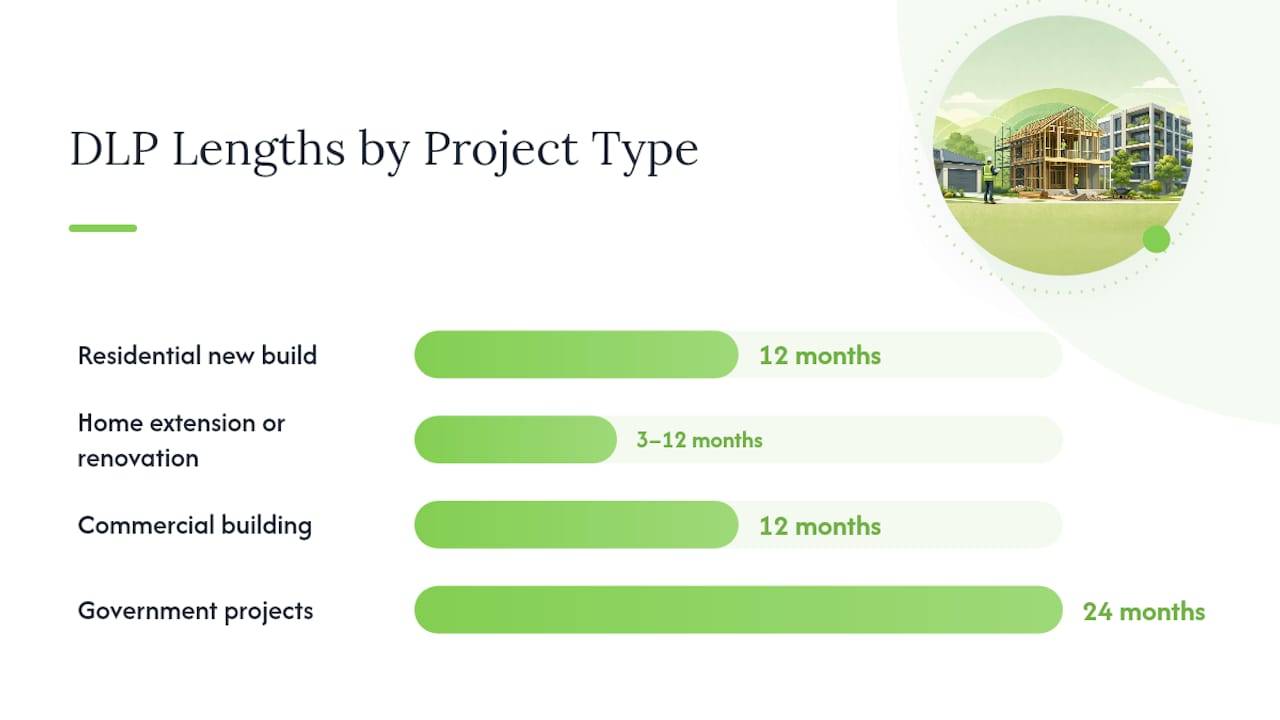
Standard-form contracts like AS 4000 and AS 4902 set out DLP mechanics but leave the duration as a contract-specific item to be agreed. If you are building a knockdown rebuild or a complex architectural project, negotiating a longer DLP for high-risk systems (façades, waterproofing, mechanical plant) is worth the conversation before you sign.
Shorter periods, say three to six months, tend to appear in small refurbishments where the scope is limited and defects are likely to surface quickly. The key is that whatever duration is written in the contract governs, so read that clause before practical completion, not after.
When does the DLP start? Practical completion, certificates, and retention
The DLP begins on the date of practical completion, which is usually confirmed by a practical completion certificate issued by the superintendent or the builder. Understanding the building process milestones helps here: practical completion does not mean the project is perfect. It means the works are fit for their intended use, with only minor defects or incomplete items remaining that do not prevent occupation.
That distinction matters because it sets the clock. From the date on the certificate, your DLP countdown begins.
Retention and security mechanics are closely tied to this moment. Retention money is a percentage of the contract sum held back by the principal to guarantee the contractor’s obligations, including defect rectification. A typical structure looks like this:
Milestone | Retention/security event |
Practical completion | Partial release |
End of DLP with no outstanding defects | Release of remaining retention balance |
Outstanding defects at DLP end | Retention held; principal may use funds to engage another party to fix issues |
The right to hold security is one of the principal’s most practical tools. If the builder refuses to return and fix a defect, the retained funds can be used to engage an independent contractor, subject to the contract’s terms and any notice requirements.
At the end of the DLP, the process typically runs: final inspection, defect list review, confirmation of rectification, superintendent issues a final certificate, and remaining retention is released. Construction Law Made Easy notes that a final certificate does not automatically extinguish future statutory claims for latent defects, which brings us to the next critical point.
Does liability end when the DLP expires?
No. This is the most common misconception we see, and it catches both homeowners and developers off guard.
The DLP is a contractual mechanism, not a legal ceiling on the builder’s liability. Once it expires, you lose the contractual right to require the builder to return and fix defects at their cost. But statutory warranties and limitation periods under state law remain available, particularly for latent defects that were not discoverable during the DLP.
State statutory frameworks to know:
Victoria: The Domestic Building Contracts Act 1995 (section 8) implies warranties into domestic building contracts, including that work will be carried out in a proper and workmanlike manner and that materials will be suitable. Limitation periods for building actions in Victoria can extend to six years or longer depending on the claim type.
New South Wales: The Home Building Act 1989 provides statutory warranties for residential building work, with separate periods for major defects (currently six years) and other defects (two years).
Queensland: The Queensland Building and Construction Commission (QBCC) administers a home warranty insurance scheme and advises including a DLP of six or 12 months in new build and major renovation contracts, with its own dispute resolution processes for defective work.
Other states and territories: Each jurisdiction has its own building legislation and regulator. The timeframes and coverage differ, so confirm the rules that apply to your project’s location.
A few practical warnings:
A final certificate does not wipe out your statutory rights. Document the date it was issued and keep it on file.
Latent structural defects (ones that were not visible or discoverable at the time of the DLP) are the most common basis for claims after the DLP expires. Photograph everything at handover and at the DLP end inspection.
The Victoria Building Authority is clear that statutory remedies survive the contractual DLP. Construction lawyers similarly caution that “defects liability period” can be misleading as a name: it describes a minimum window for contractor-funded rectification, not an absolute expiry of liability.
How to report and manage defects during the DLP
Prompt, written notification is the single most important thing you can do during the DLP. Regulators and tribunals consistently favor owners who notified early and documented thoroughly over those who compiled a list at the end of the period.
Step-by-step process:
Inspect regularly. Walk through the property at one month, six months, and again at 11 months (before the DLP expires). Do not wait for defects to accumulate.
Record immediately. Note the date and time you discovered the issue.
Photograph the defect. Wide shot for context, close-up for detail. Include a scale reference where possible.
Log it. Add the item to your defect log with: date discovered, precise location (room, wall, element), description of the defect, and photo reference numbers.
Reference the contract clause. Identify the relevant DLP clause and any workmanship standard the defect breaches.
Serve written notice. Send a formal defect notice to the builder and, if applicable, the superintendent. Email with read receipt or registered post both work; keep proof of delivery.
Set a reasonable timeframe. State a reasonable date by which you expect rectification to be completed.
Follow up in writing. If the builder does not respond or attend within the stated timeframe, send a follow-up notice and record the non-response.
A formal defect notice should capture:
Date of discovery
Precise description and location of the defect
Reference photos (numbered and attached)
The contract clause or workmanship standard breached
Requested remedy
Reasonable completion timeframe
Your contact details and the project address
Pro Tip: Keep your defect log as a shared document or spreadsheet with columns for item number, date discovered, location, description, photo reference, date notified, builder response, and date closed. Back it up to cloud storage and confirm receipt of every notice by email. This log becomes your primary evidence if the matter escalates to VCAT, NCAT, or the QBCC.
For what to expect after signing your building contract, including how defect management fits into the broader post-construction phase, Yorcon’s guide covers the full picture.
What are your options when the builder won’t fix defects?
Follow the contractual dispute-resolution steps first. Most Australian building contracts require a period of negotiation or formal notice before escalating to external bodies. Skipping this step can undermine your position.
Escalation path:
Step 1: Internal negotiation. Write to the builder formally, reference the defect notices already served, and request a response within a set timeframe (typically 10–14 days).
Step 2: Superintendent direction. If a superintendent is appointed, request they issue a formal direction to the contractor to rectify.
Step 3: Use of retention or security. If the builder fails to rectify, the principal may be entitled to use retained funds to engage another contractor, subject to contract terms and notice requirements.
Step 4: Regulator complaint. Lodge a complaint with the relevant state body: the Victoria Building Authority (including the Building and Plumbing Commission), NSW Fair Trading, or the QBCC in Queensland. Conciliation is often the first step before tribunal action.
Step 5: Tribunal. VCAT in Victoria, NCAT in NSW, and equivalent bodies in other states handle domestic building disputes. These are generally more accessible and faster than courts for residential matters.
Step 6: Court. For large or complex claims, or where tribunal jurisdiction is limited, court action may be necessary.
Evidence you will need:
Your defect log with dated entries and photos
Copies of all written defect notices and the builder’s responses (or non-responses)
The practical completion certificate and contract
Invoices for any remedial work you have already paid for
Correspondence showing the builder refused or failed to rectify adequately
If the builder becomes insolvent during the DLP: Act quickly. Document all outstanding defects immediately, notify the superintendent, and preserve any security or retention funds. Check whether the project is covered by home warranty insurance (mandatory for residential work above certain thresholds in most states), and contact the relevant insurer or state regulator without delay. The QBCC’s home warranty scheme and equivalent schemes in other states are specifically designed for this scenario.
How a proactive builder approaches the DLP
Good builders treat the DLP as an opportunity to cement client trust, not a compliance obligation to manage at arm’s length. At Yorcon, we see the period after handover as part of the project, not a separate administrative phase.
Here is what proactive DLP management looks like in practice:
Schedule inspections at 1, 6, and 11 months. Do not wait for the client to call. A scheduled walkthrough at month 11 gives time to address anything before the period closes.
Maintain a transparent defect log. Share it with the client so they can see the status of every item in real time. Transparency here prevents disputes from escalating.
Triage by priority. Safety and structural issues first, functional defects second, cosmetic items third. Communicate the triage rationale to the client so they understand the sequencing.
Set realistic repair timeframes and stick to them. If a specialist subcontractor is needed, say so and give a date. Silence is the fastest way to lose a client’s confidence.
Involve manufacturers or specialists early. For waterproofing failures, mechanical plant, or specialist finishes, bring in the right trade immediately rather than attempting a fix that may not hold.
Confirm final sign-off in writing. When all items are closed, issue a written confirmation to the client and request their sign-off. This protects both parties and formalises the end of the DLP.
Release retention promptly. Once the final certificate is issued and defects are resolved, process the retention release without delay. Holding funds beyond the contractual date creates unnecessary tension.
For different types of residential projects, the complexity of the DLP varies. A heritage renovation with original materials requires a different inspection approach than a new architectural build, and experienced project managers adjust their process accordingly.
Three scenarios that show how the DLP plays out
Scenario 1: Patent defect fixed inside the DLP
What happened: Six weeks after practical completion on a Melbourne home extension, the owner noticed cracking in the render on the new rear wall. They photographed it, logged it, and served a written notice to the builder referencing the DLP clause.

How it resolved: The builder attended within two weeks, assessed the cause (inadequate key coat application), and re-rendered the affected section. The repair triggered a fresh DLP for that specific element. The owner kept the repair invoice and a photo record of the completed work.
Lesson: Early, written notification and a clear defect log produced a fast, cost-free resolution. The restart-on-rectification clause gave the owner additional protection on the repaired area.
Scenario 2: Builder delays rectification until after the DLP expires
What happened: An owner in Queensland reported a faulty bathroom exhaust fan at month eight of a 12-month DLP. The builder acknowledged the notice but kept deferring the repair. The DLP expired before the fix was made.
How it resolved: Because the defect was notified in writing during the DLP, the owner retained their contractual right to require rectification even after expiry. They escalated to the QBCC, which facilitated conciliation. The builder ultimately completed the repair.
Lesson: Written notice during the DLP preserves your rights even if the builder delays past the expiry date. Keep every piece of correspondence.
Scenario 3: Latent structural defect discovered after the DLP
What happened: Two years after practical completion on a Victorian new build, the owner discovered significant cracking in the internal load-bearing walls, consistent with inadequate footings. The DLP had long expired.
How it resolved: Because the defect was latent (not discoverable on reasonable inspection at handover or during the DLP), the owner pursued a claim under the Domestic Building Contracts Act 1995 statutory warranties. VCAT ordered the builder to rectify.
Lesson: The DLP expiring does not close the door on serious structural defects. Statutory warranties and limitation periods exist precisely for this situation. Document everything at handover and at the DLP end inspection so you can demonstrate the defect was not visible at those points.
Why the DLP is really about trust, not paperwork
From where we stand at Yorcon, the defects liability period is less a legal formality and more a test of whether a builder actually stands behind their work. Any builder can hand over a finished home. The ones worth trusting are the ones who schedule that 11-month inspection without being asked, who pick up the phone when something is not right, and who treat a cracked tile as seriously as a structural issue.
The conventional wisdom treats the DLP as the builder’s minimum obligation. We think that framing misses the point. A well-managed DLP is the clearest signal a builder can give that they care about the outcome, not just the contract.
Three questions every homeowner should ask their builder at contract signing:
What is the exact DLP start date and duration written into this contract?
How will defects be logged and communicated during the period, and who is my point of contact?
What happens if a defect is notified before the DLP expires but not yet rectified when it ends?
And at practical completion, ask one more: “Can you walk me through the defect log process and show me how to submit a notice?” A builder who answers that question clearly and confidently is one who has done this before.
For readers wanting a broader list of questions to ask before signing, Yorcon’s questions to ask your home builder guide covers the full pre-contract conversation.
Yorcon’s approach to defect management and how to get started
Yorcon’s nearly 20 years of residential construction experience in Melbourne means we have managed hundreds of DLPs across home extensions, heritage renovations, and new builds. What sets our process apart is straightforward: a shared defect log from day one of handover, scheduled inspections at one, six, and 11 months, and a single point of contact for every defect notification. Clients never have to chase us.
If you are planning a home extension, renovation, or new build in Melbourne and want to work with a builder who treats post-construction care as part of the project, contact Yorcon for a project consultation. We are happy to walk you through our defect management process, explain what your DLP will look like for your specific project, and answer any questions before you sign.
Sources
Recommended


