
Prime Cost vs Provisional Sum: A Homeowner's Guide

Updated: Aug 17

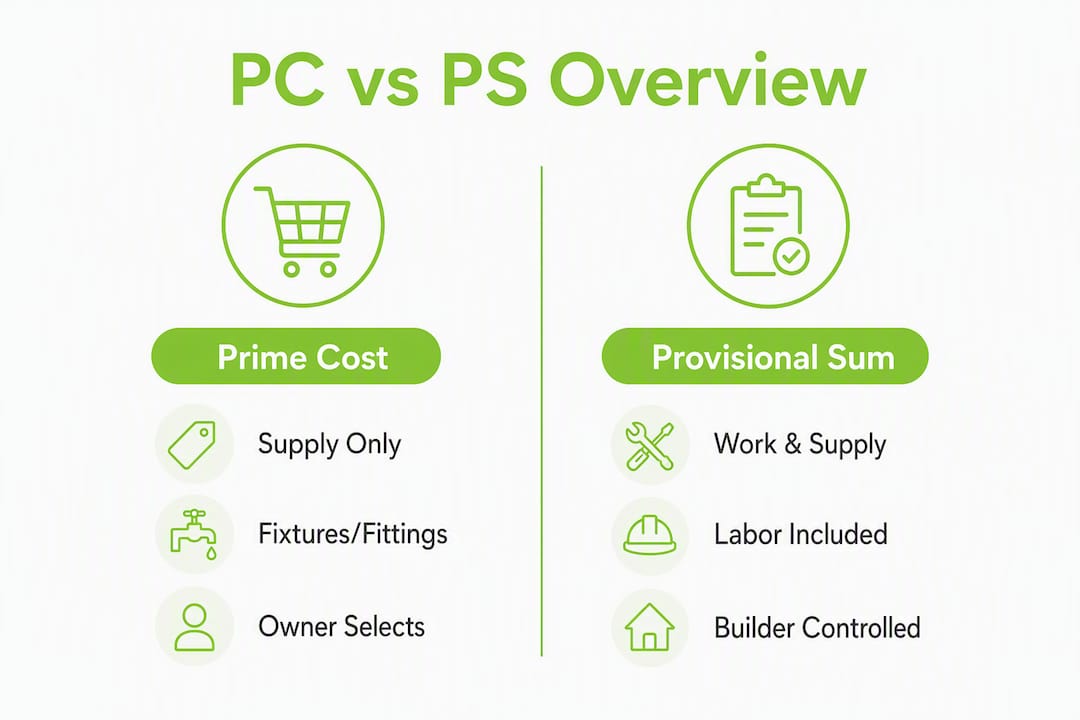
A prime cost (PC) sum covers the supply-only cost of a fixture or fitting not yet selected; a provisional sum (PS) covers an estimate for a defined scope of work, including both materials and labour. That single distinction is what separates a $500 budget surprise from a $15,000 one. Before you sign anything, open your contract’s schedule and check each allowance: does it say “supply only” or does it describe a scope of work? And does it reference a builder’s margin on any excess? Those two checks will tell you more about your real budget than the contract price itself.
The QBCC guidance statement and the Housing Industry Association (HIA) are the two authoritative sources Australian homeowners should cross-reference when reviewing these clauses.
Table of Contents
What is a prime cost sum and when does your contract use one?
A prime cost sum is an allowance for the supply and delivery of a specific fixture or fitting whose price is unknown at the time the contract is signed, usually because you haven’t selected it yet. Installation and labour are not included. The builder estimates what that item will cost to purchase, and that figure goes into the contract schedule as the PC allowance.
Common PC items you’ll see in a residential contract:
Ovens, cooktops, and rangehoods
Tapware, basins, and vanities
Tiles and floor coverings
Light fittings and ceiling fans
Door hardware and handles
In most contracts, PC allowances appear in a dedicated schedule (often called Schedule 2 or a Prime Cost Items Schedule). The figure listed is the builder’s estimated cost price, not the retail price you’d pay at a showroom, and not the installed price. When you choose an item that costs more than the allowance, you pay the difference. When you choose something cheaper, you receive a credit.

What is a provisional sum and why do builders use it?
A provisional sum is an estimate for a defined scope of work where the final cost cannot be confirmed when the contract is signed. Unlike a PC item, a PS covers both materials and labour, and often equipment hire or subcontractor costs as well. The QBCC guidance is clear that PS items are for work, not supply only.
Builders use provisional sums when site conditions are genuinely unknown. Typical examples include:
Excavation and earthworks (where rock or unexpected fill may be present)
Demolition of concealed structures
Pool installation where ground conditions vary
Complex site access works
Specialist subcontracts where scope depends on a site investigation
The quality of a PS description matters enormously. A vague PS for “excavation works — $8,000” gives you almost no protection if the actual cost triples. A well-drafted PS specifies the assumed scope, the assumed site conditions, and what would trigger a variation beyond the allowance. HIA guidance warns that PS items should never be used where the intent is supply only — that misclassification alone causes a significant share of residential contract disputes.

How do PC and PS items compare side by side?
The practical difference between the two comes down to what the allowance covers and who controls the selection.
Feature | Prime Cost (PC) Sum | Provisional Sum (PS) |
What it covers | Supply and delivery of a fixture or fitting | A defined scope of work: materials + labour |
Who selects the item | The homeowner (after contract signing) | The builder/subcontractor executes the work |
Labour included? | No | Yes |
Common examples | Oven, tapware, tiles, light fittings | Excavation, rock removal, pool installation |
Adjustment rule | Actual supply cost vs. allowance; credit or charge | Actual work cost vs. allowance; credit or charge plus builder margin |
The rule of thumb: PC = supply only; PS = work plus supply. Under some Australian standard contract variants, the line between the two can blur when drafting is imprecise, which is why clear contract language around inclusions, overheads, and profit is so important.
How do allowance adjustments actually change your contract price?
When the actual cost of a PC or PS item is confirmed, the contract price is adjusted. The mechanics are straightforward: if the actual cost is less than the allowance, the difference is deducted from your contract price. If the actual cost is more, you pay the difference, and in most contracts, the builder’s margin is added on top of that excess.
The QBCC guidance states this plainly: any credit for unused PC or PS amounts should be issued to reduce the consumer’s liability. That credit obligation is something many homeowners don’t know to ask about.
Here’s how a typical adjustment calculation works:
Allowance in contract: $3,000 (PS for earthworks)
Actual cost invoiced by subcontractor: $4,200
Excess: $1,200
Builder’s margin (e.g., 15%): $180
Total additional charge to you: $1,380
That margin on the excess is where many homeowners get caught off guard. HIA guidance specifically warns that owners often treat the allowance as the total cost, not realising that margin is applied to any overspend.
Pro Tip: Ask your builder to state the margin percentage explicitly in the contract schedule, and confirm it applies only to the excess amount, not the full actual cost. This one clause can save you thousands on a large PS item.
When an adjustment is claimed, you’re entitled to see the evidence. Always request:
The subcontractor or supplier invoice
Delivery receipts or timesheets for labour
A signed variation or adjustment notice
The margin calculation shown separately
What mistakes do homeowners make that blow the budget?
The most common mistake is treating the contract price as fixed when it contains PC and PS allowances. A contract with $80,000 in allowances is not a fixed-price contract in any meaningful sense. PC/PS items are frequently the cause of perceived fixed-price failures when those allowances are underestimated.
Ignoring the builder’s margin is the second trap. Homeowners focus on the allowance figure and forget that any overspend attracts margin on top. On a $20,000 PS for a pool excavation, a 15% margin on a $5,000 excess adds another $750 to the bill before GST.
Accepting vague PS descriptions is a risk that compounds over time. If the scope isn’t defined clearly, the builder has wide latitude to claim that additional work falls within the PS rather than requiring a separate variation. Push for specific assumed quantities and conditions in every PS description.
Not getting independent quotes before signing is perhaps the most avoidable mistake. Legal advisors recommend independent enquiries to verify that allowances reflect current market rates. A builder is required to estimate PC and PS amounts with reasonable care and skill, but a deliberately low allowance is hard to challenge after you’ve signed.
Finally, skipping a contingency on top of your allowances is a budget planning error. Even with realistic estimates, site conditions change. A 10–15% contingency on your total allowance pool is a sensible buffer for any residential project.
What should you check in your contract before signing?
Work through this checklist before you sign any residential building contract that contains PC or PS items.
Contract clauses to verify:
Each PC item has a clear description of the fixture or fitting and a stated supply-only allowance
Each PS item has a specific scope description, assumed quantities, and assumed site conditions
Labour is explicitly excluded from PC allowances and explicitly included in PS allowances
The builder’s margin percentage on excess costs is stated in the schedule (the QBCC Level 1 contract defaults to 10% if nothing is stated)
The adjustment process is described: what triggers an adjustment, what evidence is required, and when you’ll be notified
Credits for underspend are explicitly required to be passed back to you
The variation process is separate from the adjustment process, and both are clearly defined
Questions to ask your builder:
“Can you show me how each allowance was calculated?”
“What margin percentage applies to any excess on PS items?”
“Will you provide the original supplier or subcontractor invoice for every adjustment?”
“What site investigations have you done to support these PS estimates?”
“Which items could be converted from PS to a fixed price if we do more design work now?”
If the contract does not state a margin percentage, request written clarification before signing. Under the QBCC Level 1 Renovation, Extension and Repair Contract, a 10% markup applies to provisional sums if no percentage is specified. Knowing that default protects you from a builder claiming a higher rate after the fact.
Two worked examples: how allowances become actual charges
Example 1: PC item (oven supply)
PC allowance in contract: $2,500 (supply of oven)
Oven selected by homeowner: $3,800 (retail cost price to builder)
Excess over allowance: $1,300
Builder’s margin on PC excess (if contract allows, e.g., 10%): $130
Additional charge to contract: $1,430
If the homeowner had chosen an oven priced at $2,100, the contract price would reduce by $400. The installation cost is separate and already priced in the fixed portion of the contract.
Example 2: PS item (excavation)
PS allowance in contract: $6,000 (excavation, assumed standard soil, 50m²)
Actual cost (rock encountered, additional equipment required): $9,500
Excess: $3,500
Builder’s margin at 15%: $525
Additional charge to contract: $4,025
The total contract price increases by $4,025 for this single PS item. Had the builder conducted a soil test before contract signing, the PS could have been priced more accurately, or converted to a fixed-price line item. That’s the practical argument for doing more pre-contract investigation, and it’s one Yorcon actively applies on every project.
How Yorcon manages PC and PS items on Melbourne projects
At Yorcon, we’ve seen firsthand how poorly drafted allowances create friction at the worst possible time, usually mid-build when a homeowner is already stretched. Our approach is to minimise provisional sums wherever possible through pre-contract design work and site investigations. For home extensions and major renovations, that means completing soil tests, checking site access constraints, and resolving as much of the design as possible before the contract is signed.
Where PS items are unavoidable, we draft them with specific scope descriptions and stated assumptions so that any variation from those assumptions is clearly defined. Every adjustment claim we make is accompanied by the original subcontractor invoice and a written adjustment notice, so you can see exactly what changed and why. Our margin percentage is always stated in the contract schedule, not left to a default.
For PC items, we provide supplier references and estimated cost prices based on current market rates, not figures that look attractive on paper but leave you exposed at selection time. Matthew leads our pre-contract process with a detailed review of every allowance in the schedule, and we encourage clients to get independent quotes on high-value PC items before signing. If you’re undertaking a heritage renovation or a project with significant earthworks, the PS risk is higher, and we’ll tell you that upfront.
Key Takeaways
A prime cost sum covers supply only; a provisional sum covers a full scope of work including labour, and both types of allowances can increase your contract price when actual costs exceed the estimate.
Pointu | Details |
PC vs PS core difference | PC covers supply and delivery only; PS covers materials, labour, and a defined scope of work. |
Builder margin on excess | Margin applies to any overspend on both PC and PS items — always ask for the percentage in writing before signing. |
Credits for underspend | If actual costs are lower than the allowance, the difference must be credited back to reduce your contract price. |
Reduce PS risk early | Pre-contract soil tests, site access checks, and completed design work convert uncertain PS items into fixed-price lines. |
Yorcon’s approach | Yorcon states margin percentages in the contract schedule, provides subcontractor invoices for every adjustment, and minimises PS items through pre-contract investigation. |
Why clear allowances matter more than a low contract price
There’s a version of this conversation we have with homeowners regularly, and it goes something like this: two builders quote the same project. One comes in $30,000 lower. The lower quote has $60,000 in provisional sums; the higher one has $15,000. Which is actually cheaper?
The honest answer is that you can’t tell from the contract price alone. A low headline number built on optimistic allowances is not a competitive quote. It’s a deferred invoice. And the frustrating part is that by the time you find out, you’re already committed.
What I’d encourage any homeowner to do is treat the total allowance pool as a variable, not a fixed cost. Add a realistic contingency, verify the margin clause, and push for independent pricing on any PS item over $5,000. The builders who resist that transparency are telling you something important about how they manage projects. The ones who welcome it, and can show you the workings, are the ones worth trusting with your home.
Yorcon can help you review your contract before you sign
Understanding allowances in building contracts is one thing. Having a builder who structures them fairly from the start is another. At Yorcon, we work with Melbourne homeowners on home renovations and extensions where PC and PS items are part of every project, and we build our schedules around transparency, not optimism.
If you’re reviewing a contract and want a second opinion on the allowances, or if you’re starting a project and want it structured to minimise budget risk, we’d be glad to talk through the details. Reach out to the Yorcon team to discuss your project and get a clear picture of what your allowances actually mean for your final build cost.
Recommended


