
Why Material Selection Matters for Your Australian Home

Updated: Aug 17

Material selection determines a home’s lifetime durability, maintenance burden, thermal comfort, and embodied carbon — and getting it wrong costs far more than the upfront savings suggest. Whether you’re planning a new build, an extension, or a renovation, the materials you choose shape everything from how your home handles a coastal storm to how much you’ll spend on repairs in twenty years. The National Construction Code (NCC) requires all materials to be fit for purpose, and Australian Government sustainable building guidance adds a further layer: choose materials that are honest, durable, and appropriately matched to your climate zone. At Yorcon, we see the consequences of poor material decisions on Melbourne projects every year — and the good news is that most of them are entirely avoidable.
The core consequences of material choice fall into four areas:
Lifecycle cost: cheaper materials often trigger expensive repair cycles within a decade or so
Climate resilience: coastal corrosion, termite attack, bushfire exposure, and UV degradation vary sharply by site
Indoor air quality: off-gassing from synthetic finishes and moisture-trapping assemblies affect occupant health
Resale and value: material quality and design compatibility directly influence buyer perception and long-term property value
Table of Contents
Why does material choice change your home’s total cost?
The instinct to save money upfront is understandable, but it routinely backfires. Financial life-cycle costing evaluates a material’s total cost across its full service life — purchase, installation, maintenance, repair, replacement, and disposal — rather than just the purchase price. When you run those numbers, durable materials almost always win.
Consider a practical comparison: a lower-grade painted fibre cement cladding might cost 20% less to install than a premium pre-finished composite, but if it requires repainting every 7–8 years versus every 20+ years, the recurrent labor and materials cost swings the lifetime figure decisively the other way. Recurrent embodied energy from repair and replacement can represent around 19–34% of a building’s total lifecycle energy demand depending on material service life — a figure most homeowners never see in a quote.
Key questions to ask when comparing materials on cost:
What is the manufacturer’s stated service life, and is it backed by a warranty?
What maintenance does the material require, and at what intervals?
What is the replacement cost if the material fails early?
Does the material’s performance degrade in your specific climate zone?
Poor maintenance can halve a material’s lifespan, negating the embodied energy invested in producing it and effectively doubling your materials consumption over the building’s life. Lifecycle thinking isn’t just an environmental principle — it’s sound financial planning.
How do you match materials to your Australian site?
Australia’s climate diversity means there is no single best material for every project. A material that performs beautifully in Melbourne’s temperate climate may corrode, warp, or fail within a decade on a Queensland coastal site. Building professionals stress corrosion resistance for coastal exposure and using thermal mass appropriately to local climate zones to maximise comfort.
The primary resilience factors to assess for any Australian site:
Coastal corrosion: steel, aluminium, and fixings need marine-grade specifications within 1 km of the coast; standard-grade products can fail within 5 years
Termite resistance: treated timber, concrete, steel, or physical termite barriers are mandatory in high-risk zones under the NCC
Bushfire Attack Level (BAL): AS 3959 governs material and construction requirements for bushfire-prone land; non-compliant cladding is a safety and insurance risk
Moisture and UV resistance: Melbourne’s variable weather demands materials with proven moisture management and UV-stable finishes
For thermal comfort, YourHome guidance recommends pairing high-mass materials (brick, concrete, rammed earth) with passive solar design in climates with large diurnal temperature swings, while lightweight, well-insulated construction suits climates where rapid heating and cooling is needed. Mass without passive design delivers little benefit.
Pro Tip: Before purchasing any material for a structural or external application, request the supplier’s Accredited Testing Laboratory report confirming fitness for your specific climate zone and hazard class. This document is your evidence trail if a product fails.
What does sustainability actually mean when choosing materials?
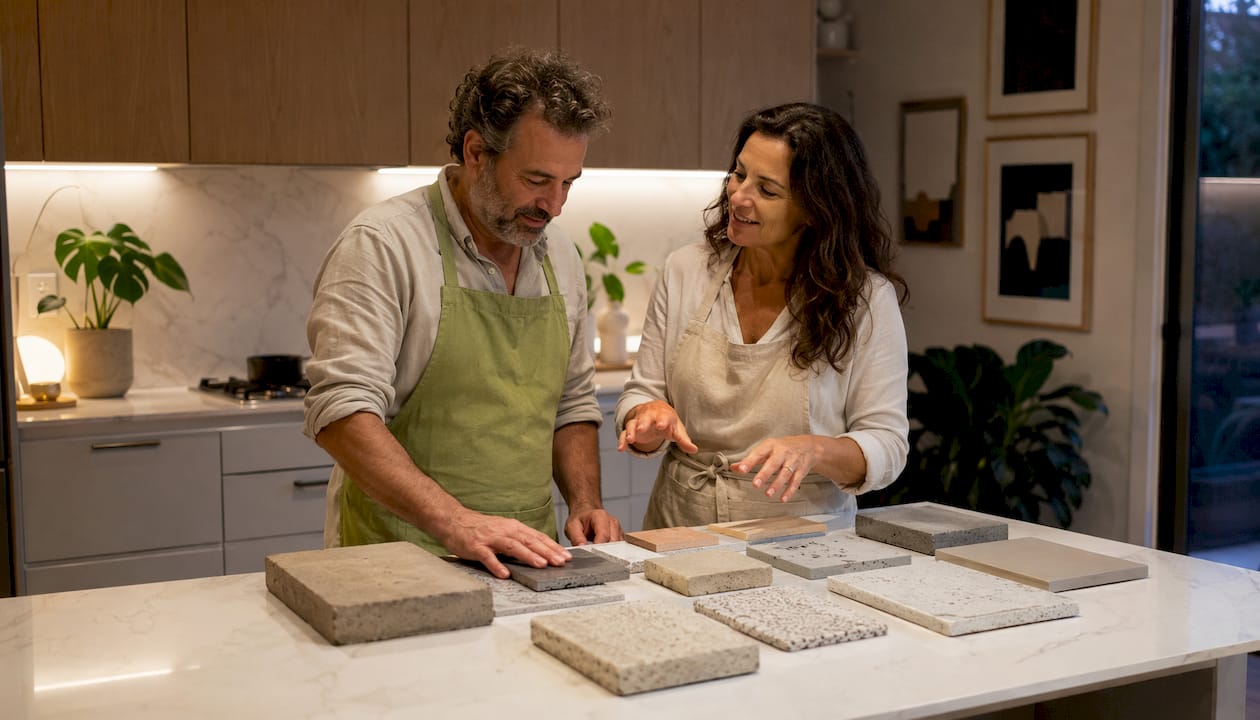
Embodied energy is the total energy consumed to extract, manufacture, and transport a building material before it ever reaches your site. Embodied carbon is the associated greenhouse gas emissions. These are distinct from operational energy (heating, cooling, lighting) — and for a well-insulated modern home, upfront embodied carbon can represent a significant share of the building’s total lifecycle emissions.
The superstructure, external walls, and windows drive most of a home’s upfront embodied carbon. Concrete and aluminium are frequently the highest contributors in Australian residential projects; timber-framed buildings tend to carry lower embodied emissions for the same floor area, though individual design optimisation matters more than broad generalisations.
Two principles from Australian Government sustainable building guidance are worth building into every brief:
Material honesty: use materials in their natural state where appropriate, avoiding unnecessary coatings or claddings that add embodied energy and maintenance without adding performance
Reductionism: build less by removing redundant finishes and layers, which lowers both embodied energy and long-term maintenance burden
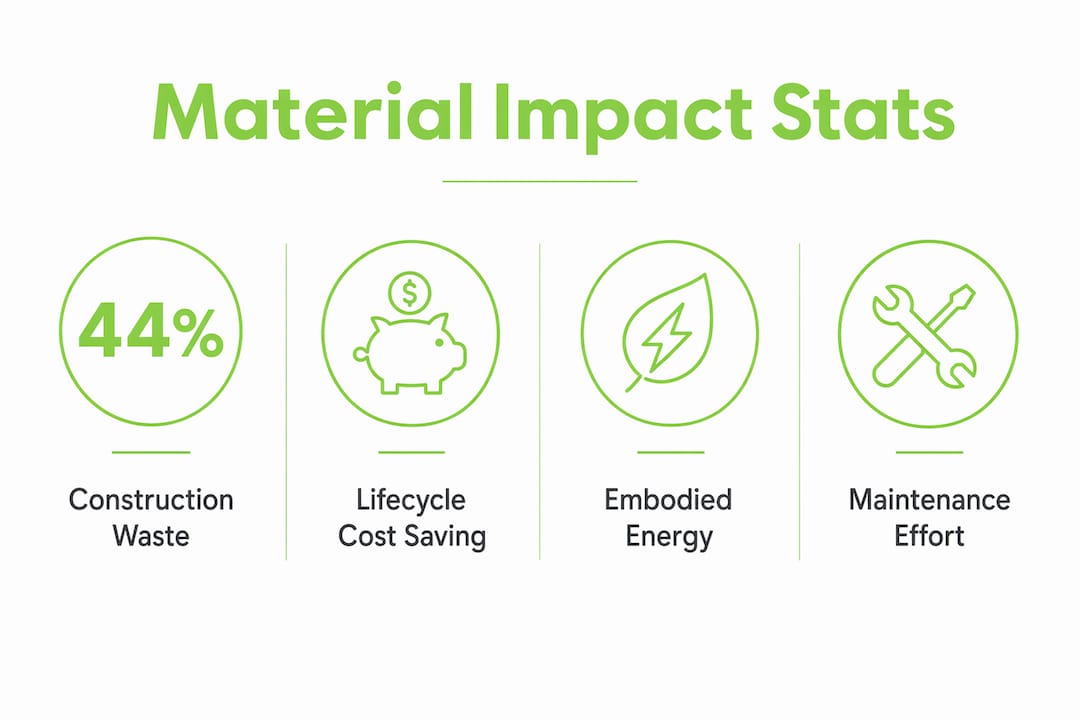
Construction waste represents approximately 44% of Australian waste streams, making local sourcing and recycled-content materials a meaningful lever for reducing a project’s environmental footprint. Specifying recycled-content concrete or locally sourced timber cuts transport emissions and supports regional supply chains. For more on how these principles translate into a complete build, Yorcon’s sustainable custom home building guide covers the practical application in detail.
How do you choose the right materials for your project?
A structured checklist prevents the most common and costly mistakes. Work through these steps before finalizing any specification:
Define your site and climate needs — climate zone, BAL rating, coastal proximity, termite risk
List performance criteria — durability, fire resistance, termite resistance, UV stability, maintenance interval
Check embodied carbon and recyclability — prefer lower-carbon alternatives where performance is equivalent
Confirm NCC fitness-for-purpose — request test reports, product certificates, and warranties
Consider local sourcing — locally manufactured materials reduce transport emissions and support supply chain reliability
Assess service life — longer service life reduces recurrent embodied energy and lifecycle cost
Questions to ask suppliers and subcontractors:
Question | What you’re checking |
Can you provide an Accredited Testing Laboratory report? | Independent performance verification |
What is the product’s stated service life and warranty? | Lifecycle cost reliability |
What maintenance does this material require, and how often? | Ongoing cost and effort |
Is this product compliant with the relevant Australian Standard? | NCC fitness-for-purpose |
Where is this material manufactured or sourced? | Embodied carbon and supply risk |
Red flags to watch for: vague warranty language (“subject to conditions”), no independent test certification, service life claims unsupported by data, and substitution clauses that allow the builder to swap specified materials without your approval.
Pro Tip: Build your material specifications into the contract scope-of-works with the product name, grade, and test certificate reference. This prevents late substitutions and gives you clear recourse if a product underperforms.
What are the trade-offs between common Australian building materials?
Material | Thermal mass | Embodied energy | Maintenance level | Resilience notes |
Brick/masonry | High | Moderate | Low | Excellent termite and fire resistance; poor in high-seismic zones |
Concrete (reinforced) | High | High | Low–moderate | Durable; optimising mix design reduces embodied carbon |
Timber frame | Low | Low–moderate | Moderate | Requires treatment for termites and moisture; lower embodied carbon |
Engineered timber (CLT/LVL) | Moderate | Low–moderate | Low–moderate | Strong lifecycle credentials; growing availability in Australia |
Steel frame | Low | High | Low | Requires thermal breaks per NCC; marine-grade needed near coast |
Aluminium/composite cladding | Low | High | Low | High embodied carbon; durable with correct specification |
AAC (autoclaved aerated concrete) | Moderate | Moderate | Low | Good thermal performance; lightweight; termite resistant |
YourHome’s construction systems guidance notes that no single material wins across all criteria — the right choice depends on climate zone, passive design strategy, and site hazards. Engineered timber and AAC are worth serious consideration as lower-impact alternatives to reinforced concrete in many Melbourne applications. For a deeper look at material choices for Melbourne renovations, Yorcon’s blog covers local trade-offs in practical detail.
Understanding how durable construction reduces lifetime repair costs is a useful complement to the trade-off table above, particularly for homeowners weighing upfront cost against long-term value.
Which Australian codes and certifications should you check?
The NCC is the non-negotiable starting point. It sets minimum requirements for safety, health, amenity, and sustainability, and it requires documented evidence that materials are fit for purpose for the specific site and climate zone. NCC Volume Two governs residential buildings.
Beyond the NCC, the following checks matter:
Australian Standards: AS 3959 (bushfire), AS 3660 (termite management), AS/NZS 4859.1 (insulation) — request compliance documentation for each relevant standard
NatHERS: the Nationwide House Energy Rating Scheme scores thermal performance; material choices directly affect the star rating
Green Star: voluntary but increasingly expected on higher-specification projects; covers embodied carbon, indoor environment quality, and materials transparency
Global GreenTag and Good Environmental Choice Australia (GECA): third-party lifecycle certification schemes that verify environmental claims on specific products
Always request the supplier’s product certificate, test report, and warranty document before signing off on a specification. Verbal assurances are not sufficient under NCC governing requirements.
How Yorcon approaches material decisions on Melbourne projects
On a recent Melbourne inner-suburb renovation, the brief called for a rear extension with a mix of heritage brick and contemporary cladding. The original specification included a standard painted fibre cement sheet for the new addition. After running a lifecycle cost comparison, the team shifted to a pre-finished composite panel with a 25-year warranty — a higher upfront cost, but a projected saving in repainting and maintenance over the building’s life. The structural frame used treated LVL (laminated veneer lumber) rather than steel, reducing embodied carbon while meeting NCC bushfire and termite requirements for the site’s BAL rating.
The outcome: a thermally comfortable, low-maintenance addition that matched the heritage streetscape and met all NCC performance requirements from day one.
Key Takeaways
Material selection is the single most consequential decision in residential construction — it determines lifetime cost, climate resilience, sustainability, and occupant comfort before a single wall goes up.
Point | Details |
Lifecycle cost beats upfront price | Recurrent embodied energy can represent a significant share of total lifecycle energy; durable materials reduce this burden. |
Match materials to your site | Assess BAL rating, coastal proximity, termite risk, and climate zone before specifying anything. |
Check NCC fitness-for-purpose | Request Accredited Testing Laboratory reports, Australian Standards compliance, and warranty documents for every material. |
Embodied carbon starts at structure | Superstructure, external walls, and windows drive most upfront embodied carbon — prioritise lower-carbon options here. |
Engage Yorcon early | Bringing a builder into material conversations at design stage prevents costly late substitutions and compliance gaps. |
The part of material selection most people underestimate
There’s a tendency to treat material selection as a finishing conversation — something you sort out once the design is locked and the budget is set. In practice, that’s exactly backwards. The structural and envelope decisions made in the first few weeks of a project lock in the majority of a home’s embodied carbon, its thermal performance trajectory, and its maintenance profile for the next 30–50 years. By the time a homeowner is choosing between two cladding options at a showroom, the most consequential choices have already been made.
What we find on Melbourne projects is that the clients who get the best outcomes are the ones who bring material questions into the design brief, not the construction phase. They ask about service life before they ask about colour. They want to know the maintenance schedule before they commit to a finish. That discipline — treating materials as a performance decision first and an aesthetic decision second — is what separates a home that ages gracefully from one that starts showing its problems within a decade.
The other thing worth saying plainly: the NCC sets a floor, not a ceiling. Compliance is the minimum. The materials that genuinely serve a Melbourne home well over its lifetime are usually a step above minimum spec, and the lifecycle cost math almost always justifies that step.
Yorcon brings material expertise to your Melbourne project
Nearly 20 years of building and renovating Melbourne homes has taught us that the right material conversation happens at the design table, not the hardware store. Yorcon’s home extensions and renovation services include documented material-selection advice, NCC fitness-for-purpose checks, and lifecycle costing input as part of the build process — not as an add-on.
Whether you’re extending a Victorian terrace, refreshing a mid-century home, or starting from scratch, we coordinate material decisions with your design intent from day one. That means fewer surprises, better long-term performance, and a home that holds its value. Contact Yorcon to discuss your project and get a clear picture of which materials will serve your home best for the decades ahead.
Further reading and authoritative sources
National Construction Code (NCC) — ABCB: Australia’s primary technical standard for building design and construction; the definitive reference for fitness-for-purpose requirements and climate zone compliance.
YourHome (Australian Government): Practical guidance on construction systems, materials, embodied energy, and lifecycle performance — written specifically for Australian conditions.
MDPI — Embodied Carbon in Australian Residential Houses: Research-grade analysis of embodied carbon by material category and structural system in Australian residential construction.
MDPI — Optimisation of Embodied Carbon and Thermal Performance of Roof Material Selections: Detailed study on balancing R-value requirements with embodied carbon in roof assemblies under Australian sustainability policy.
Architects’ guidance on financial life-cycle costing (RAIA Acumen): Industry-standard methodology for comparing materials on total lifetime cost rather than purchase price alone.
Recommended


