
Soil test cost Melbourne: what homeowners can expect to pay

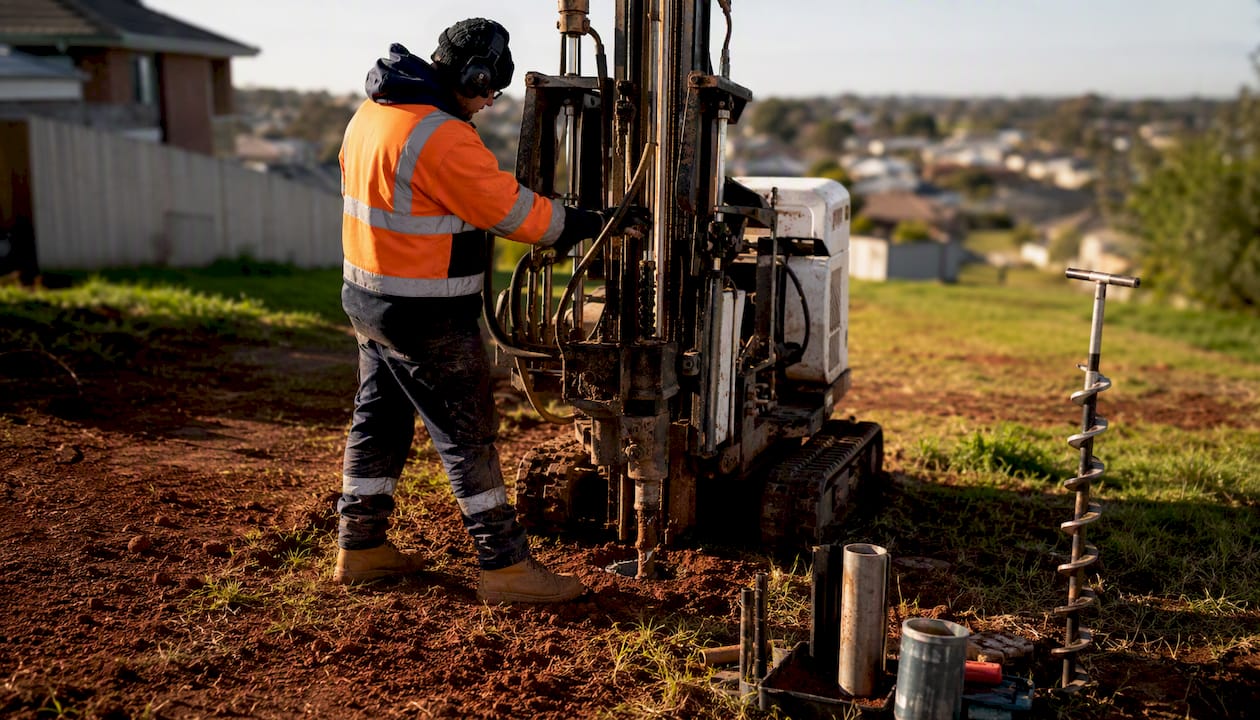
A standard AS 2870 site classification in Melbourne typically costs $500 to $900 for a straightforward suburban block, GST included, with more complex sites running from $1,000 up to $3,000 or more. That fee usually covers one to two boreholes, basic shrink-swell lab testing, and a written report classifying your site under AS 2870. The fee typically covers a site visit, borehole logging and a formal classification report you can hand straight to your engineer or building surveyor.
Here’s the one thing worth doing before anything else: get that report before you buy land or sign a building contract. Melbourne’s clay soils shift more than most buyers realise, and a $600 test now can save you from a foundation redesign that costs tens of thousands later.
Key Takeaways
A standard AS 2870 site classification in Melbourne costs $500 to $900 for most suburban blocks, and getting one before signing a build contract is the single most effective way to avoid foundation cost surprises.
Point | Details |
Standard price band | Expect $500 to $900 for a straightforward suburban block with one to two boreholes. |
Cost drivers | Uncontrolled fill, poor access, slope, and multi-unit overlays all push quotes higher. |
AS 2870 classifications | Sites are rated A, S, M, H1, H2, E or P, determining footing design requirements. |
Class P isn’t a rejection | It signals a need for site-specific engineering, not an automatic project stop. |
Report turnaround | Most Melbourne providers deliver within 8 to 10 business days of the site visit. |
Yorcon’s role | Yorcon arranges soil testing quotes and folds classification results into fixed-price proposals. |
Table of Contents
What makes a soil test cost more or less in Melbourne
Not every quote is comparing the same job. A handful of factors push the price up or keep it lean, and knowing them means you can read a quote properly instead of just looking at the bottom line.
Number and depth of boreholes: most standard blocks need one to two bores at around 1.5 to 3 metres, but sloped or larger sites often need three or four.
Uncontrolled fill: if the site has been filled in the past (common on older subdivided blocks), engineers often need extra bores or supplementary investigation to work out what’s underneath.
Site access: a tight inner suburban block with no side access for a drill rig costs more to test than an open bayside block where the rig can drive straight in.
Slope and soil variability: hilly sites in the Dandenong foothills or the Yarra Valley fringe often need more sampling points than flat sandbelt land around Brighton or Cheltenham.
Multi-unit projects and overlays: townhouse developments and sites under an Environmental Management Overlay (EMO) usually need more boreholes and extra council-driven paperwork.
Travel and lab fees: outer growth corridors and semi-rural fringe suburbs can attract a call-out surcharge on top of the base fee.
Pro Tip: Ask every provider for a written itemised quote before they book the job, not just a verbal figure over the phone. Get them to confirm the number of boreholes, whether lab testing is included, and whether the price is inclusive of GST. That one question avoids most of the “surprise invoice” complaints homeowners raise after the fact.
Types of soil tests and realistic Melbourne price bands
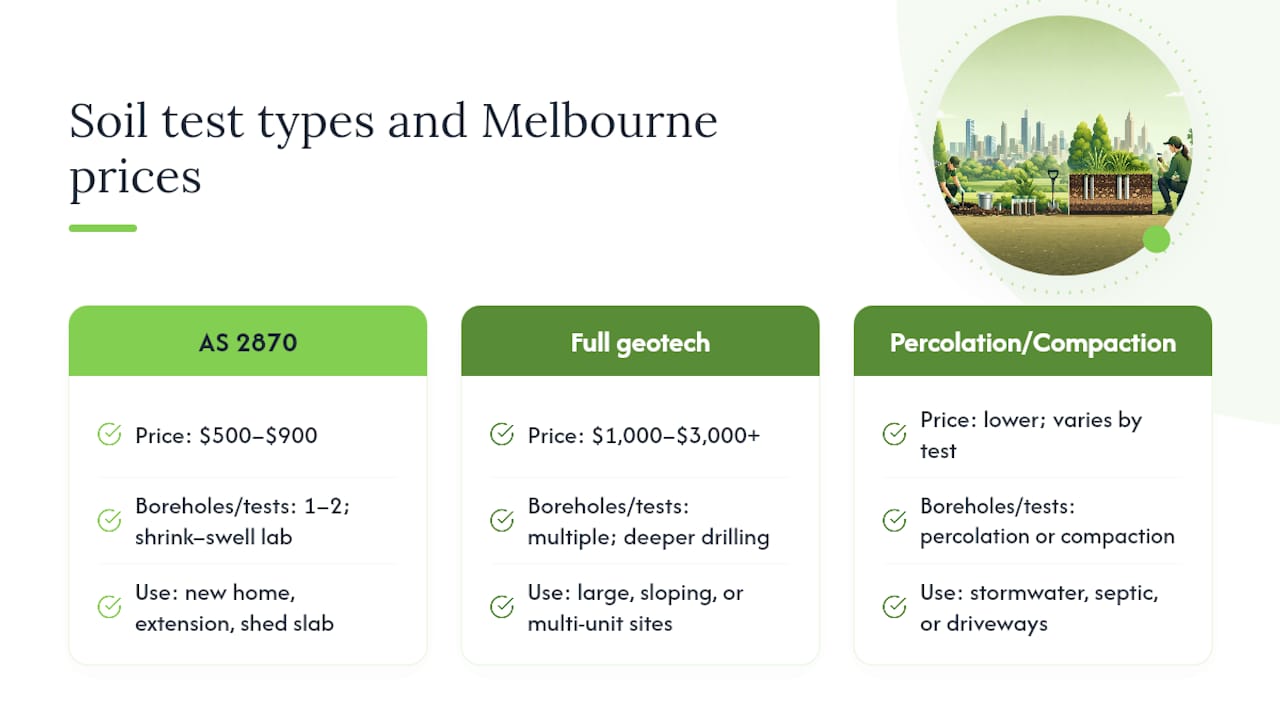
Soil testing isn’t one product with one price. The term covers several distinct services, and mixing them up is the fastest way to end up with the wrong report for your project.
An AS 2870 site classification is the one you need for a new home, extension, or shed slab. It typically runs $500 to $900 for a standard suburban block, according to Smolders Geotechnical, though HomeBuild HQ puts the broader Melbourne range at $450 to $1,400 depending on access and reactivity. A percolation or infiltration test, used mainly for stormwater or septic design, sits at a lower price point and is a different test entirely. Compaction testing, common on filled sites or driveways, is priced separately again. A full geotechnical investigation with multiple boreholes, deeper drilling, and advanced lab profiling for larger or sloping sites can climb well past $1,000, sometimes into the $2,000 to $3,000-plus range for complicated multi-unit work.
Typical quote for a standard block: one to two boreholes, shrink-swell lab testing, and an AS 2870 classification report, landing somewhere in the $500 to $900 band before any add-ons.
Consumer guides like hipages list a national range of roughly $390 to $900 for simple sites, climbing above that for specialised or multi-location work. It’s worth remembering that a garden fertility test or a percolation test is not a substitute for an AS 2870 classification. If your builder or certifier needs a site class for footing design, you need the engineering report, not the agricultural one.
What’s in an AS 2870 report, and what does Class P mean?
AS 2870:2011 is the Australian Standard governing residential slab and footing design, and it works by sorting sites into reactivity classes so engineers know how much a foundation needs to withstand ground movement. A compliant report from a provider like Southern Geotechnical or Smolders Geotechnical should include a summary, borehole logs, lab results, the final classification, and specific founding recommendations, usually issued within 8 to 10 business days.
The classifications run as follows:
Class A: stable, non-reactive site, minimal ground movement expected.
Class S: slightly reactive clay, low movement.
Class M: moderately reactive clay, common across much of Melbourne’s west and north.
Class H1 and H2: highly reactive clay, common in older reactive-clay suburbs, requiring stiffer footing systems.
Class E: extremely reactive, usually needing engineered slab or piered footing solutions.
Class P: problem site, often due to uncontrolled fill, soft soil, or slope instability.
Class P tends to alarm homeowners the moment they see it on a report, but it isn’t a rejection notice. It simply flags that the site needs site-specific engineering rather than a standard footing design, and it usually means one more design step before construction, not a dead stop.
Who prepares the report, and how long does it take?
A soil site classification has to be prepared by a suitably qualified geotechnical engineer or geologist, not a general contractor. That qualification matters because the classification underpins every footing calculation your structural engineer will make later.
Standard turnaround: most Melbourne providers deliver a report within 8 to 10 business days of the site visit.
Priority or express service: available from some providers for an extra fee if your building permit timeline is tight.
Delays to expect: complex sites, extra boreholes, or lab backlogs during peak building season can push turnaround out by a week or more.
Councils and building surveyors typically require this report before issuing a building permit, and savvy buyers request one during due diligence, before they’ve even settled on a block. If you’re at the land-buying stage, this is the report to commission first.
How to get accurate quotes and what to ask providers
Getting comparable quotes takes a bit more than ringing three companies and asking “how much?” Here’s a simple way to scope it properly.
Define the job: decide whether you need a basic AS 2870 classification or a fuller geotechnical investigation.
Gather site details: have your address, block size, and any known fill or slope information ready.
Request itemised quotes: ask for a breakdown, not a lump sum.
Compare like for like: check that every quote covers the same number of boreholes and lab tests.
When you’re on the phone with a provider, ask these directly:
Who attends the site, and what are their qualifications?
Exactly how many boreholes and lab tests are included in the price?
What’s the extra-metre rate if drilling goes deeper than expected?
Are footing probes for extensions included, or charged separately?
What’s the turnaround, and is the provider insured?
Why skipping the test costs more than the test itself
Reactive Melbourne clays that aren’t properly classified can lead to under-designed footings, cracking, and repair bills that stretch into the tens of thousands. Local council guidance frames early testing as risk mitigation, not a formality.

A $600 test now is cheap insurance against a slab redesign mid-build. Skipping it just moves the cost, and the stress, further down the timeline.
A builder’s view on getting soil testing right
We build soil testing into the design phase from day one, because sorting it early avoids expensive footing surprises later. Bundling it with the contour survey, and using our regular geotechnical partners, keeps costs down and timelines tight.
How Yorcon handles soil testing for your build
Coordinating a geotechnical report on top of permits, drawings, and trades quotes is exactly the kind of admin that turns a home build into a headache. Yorcon manages that legwork as part of pre-construction, arranging soil testing quotes, reviewing the AS 2870 classification with our engineers, and folding the results straight into your fixed-price proposal so there are no nasty surprises once footings go in.
Because we run this process on every project, from heritage renovations to knockdown rebuilds, we already know which local geotechnical partners deliver reliable reports on realistic timelines. If you’re planning a home extension and need footing probes on your existing foundations, or a full rebuild that needs a fresh site classification, get in touch with Yorcon to bundle your soil testing with the rest of your pre-construction planning and get a clearer, earlier picture of your build costs.
Where to check the standards and local guidance
AS 2870-2011 for the official residential site classification standard.
Monash City Council for local soil investigation guidance.
Always confirm the publication date and scope of any standard or council document before relying on it.
Frequently asked questions
How much does a soil test cost in Melbourne? Most standard suburban blocks cost $500 to $900 for an AS 2870 site classification, with complex or filled sites running higher, sometimes past $1,400.
Is soil testing worth it for a small extension? Yes, particularly if you’re adding load near existing footings. A footing probe confirms depth and condition before your engineer designs the connection.
Do I need a soil test before buying land in Melbourne? It’s strongly recommended. A pre-purchase classification tells you whether the site is Class M, H1, H2, or worse, Class P, before you commit.
What does Class P mean for my build? It means the site needs specific engineering input, not that your project is refused. Most Class P sites still get built on, with an adjusted foundation design.
How long does a soil test report take? Typically 8 to 10 business days from the site visit, though priority services and complex sites can shift that timeline.
Sources
Recommended


