
Lock a Defensible Melbourne Renovation Budget: Per Trade Breakdown

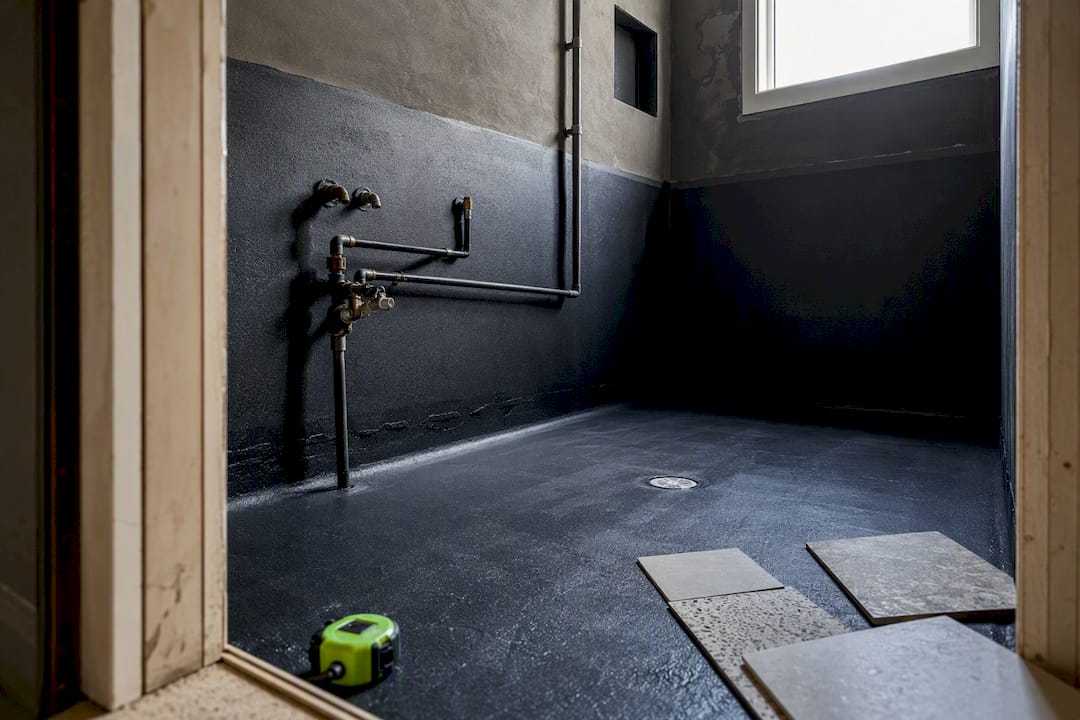
Expect to spend somewhere between $2,000 and $7,500 per square metre depending on scope and finish, with a full home renovation landing in a wide price range. Kitchens and bathrooms typically consume the biggest share of that budget. Whatever your total comes to, hold back 10 to 20% as contingency, and push that closer to 20% if you’re working on an older home or touching structural elements.
TL;DR:
Moving plumbing or electrical service points significantly increases costs and should be minimized if budget control is a priority.
Structural work and high-end joinery push renovation costs into the premium tier, especially in kitchens and bathrooms.
Contingency funds should be set at 20% for projects touching structural elements or built before 1990 to avoid budget overruns.
Per-square-metre estimates are only a starting point; trade-by-trade pricing provides a more accurate, defensible budget.
A comprehensive scope and signed variation processes are essential for preventing scope creep and unexpected expenses during renovation.
Table of Contents
Renovation budget breakdown by the numbers: per-m² bands and project totals
Per-square-metre pricing is the fastest way to sense-check a quote, but it only works as a starting point, not a final figure. Three tiers cover most Melbourne projects:
Cosmetic refresh: $2,000–$3,000/m². Think new paint, flooring, and fixture swaps without moving walls or services.
Standard renovation: $3,000–$5,000/m². This covers layout changes, new joinery, and a genuine upgrade to finishes throughout.
Premium renovation: $5,000–$7,500+/m². Structural work, custom cabinetry, and higher-end fixtures push costs into this band.
Translate those rates into whole-project figures and a cosmetic refresh of a modest home might land around $60,000 to $120,000. A standard mid-range renovation across a typical three-bedroom house often runs $150,000 to $300,000, and a full gut renovation or architectural rebuild can stretch to $550,000 or beyond, particularly once you’re reconfiguring the whole floor plan.
Here’s the catch with per-m² figures: wet areas and joinery-heavy rooms pack enormous cost into a small footprint, so a house with a large kitchen and two bathrooms will always price higher per square metre than one with the same floor area but simpler bedrooms and living zones. Use these industry bands to validate a quote you’ve already received, not to generate your budget from scratch. The real number comes from pricing each trade individually, which we’ll walk through shortly.
What does each room cost to renovate?
Kitchens and bathrooms aren’t just expensive, they’re disproportionately expensive. That’s the trade off worth understanding before you start allocating dollars.
Pro Tip: If you’re tight on budget, spend less on the rooms guests see (living areas, entries) and protect the spend in kitchens and bathrooms. Cosmetic finishes are cheap to upgrade later. Waterproofing and plumbing rough ins are not.
Kitchens
A budget kitchen renovation sits between $12,000 and $25,000, and gets you new benchtops, cabinetry doors, and updated appliances without moving plumbing or gas points. Step up to a mid-range kitchen and you’re looking at $25,000 to $45,000, which typically includes a full cabinetry rebuild, stone benchtops, and a layout reconfiguration. Premium kitchens, with custom joinery, integrated appliances, and stone splashbacks, run $45,000 to $80,000 or more.
Cabinetry alone often represents 30 to 40% of the total kitchen budget, according to RenoGuide’s cost analysis, which is why semi-custom joinery is one of the biggest levers you have for pulling a quote back into range.
Bathrooms
Budget bathroom renovations start around $8,000 to $15,000, covering a straight swap of fixtures, tiling, and a new vanity within the existing footprint. Mid-range bathrooms, where you’re moving the shower, adding a bath, or reworking the layout, land between $15,000 and $35,000. Premium bathrooms with freestanding baths, heated floors, and full stone surfaces can reach $35,000 to $60,000 or higher. Waterproofing membranes and compliance testing add a fixed cost regardless of tier, and skipping corners here is the single most expensive mistake we see homeowners regret.
Laundries, bedrooms and living areas
Laundries are the cheapest wet area to renovate, generally $6,000 to $15,000, since the footprint is small and there’s usually no structural change involved. Bedrooms without ensuite work are mostly cosmetic and price closer to $150–$300/m² for paint, flooring, and built in robes. Open plan living and dining renovations vary widely because they’re often where structural walls come down. Removing a load bearing wall to open a kitchen into a living space can add $5,000 to $15,000 in structural engineering and support alone, on top of the finishing costs.
Extensions and second storey additions
Ground floor extensions typically price at $2,500 to $4,000/m² for a standard build, covering new footings, framing, roofing, and services. Second storey additions cost more per square metre, often $3,500 to $5,500/m², because you’re working with existing structure, scaffolding, and temporary weatherproofing. A single bedroom and bathroom extension might total $120,000 to $220,000 depending on finish level and site access. If your project includes an extension alongside your renovation, price the two scopes separately before combining them into one number, because they draw on different trades at different intensities.
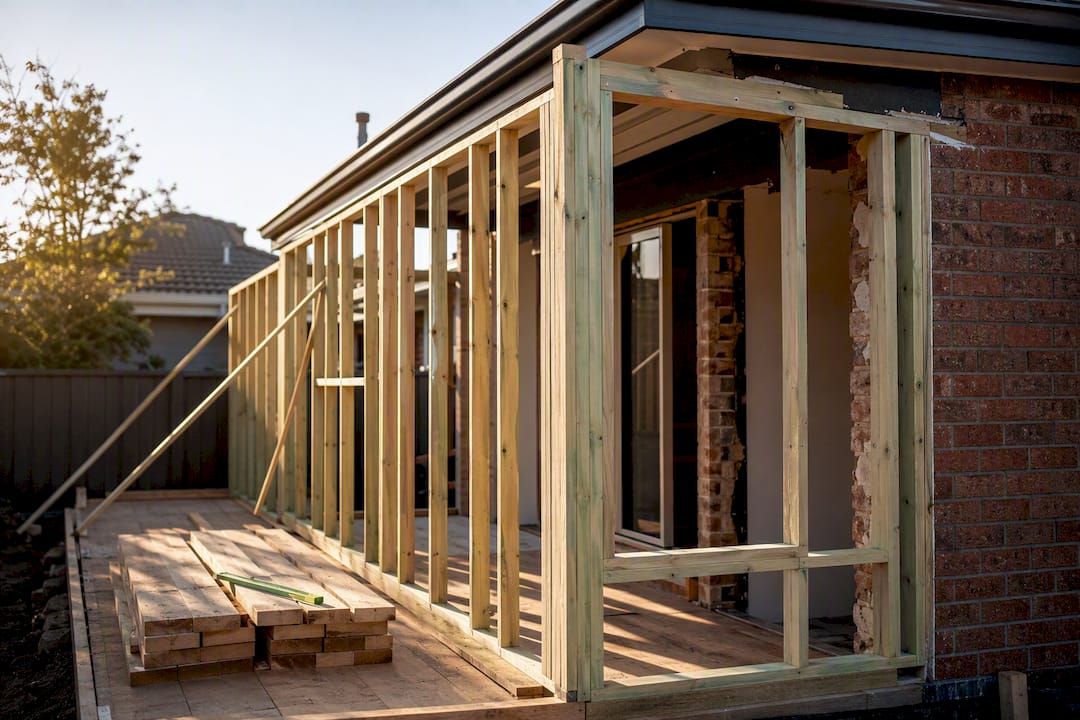
How should your renovation budget be split across categories?
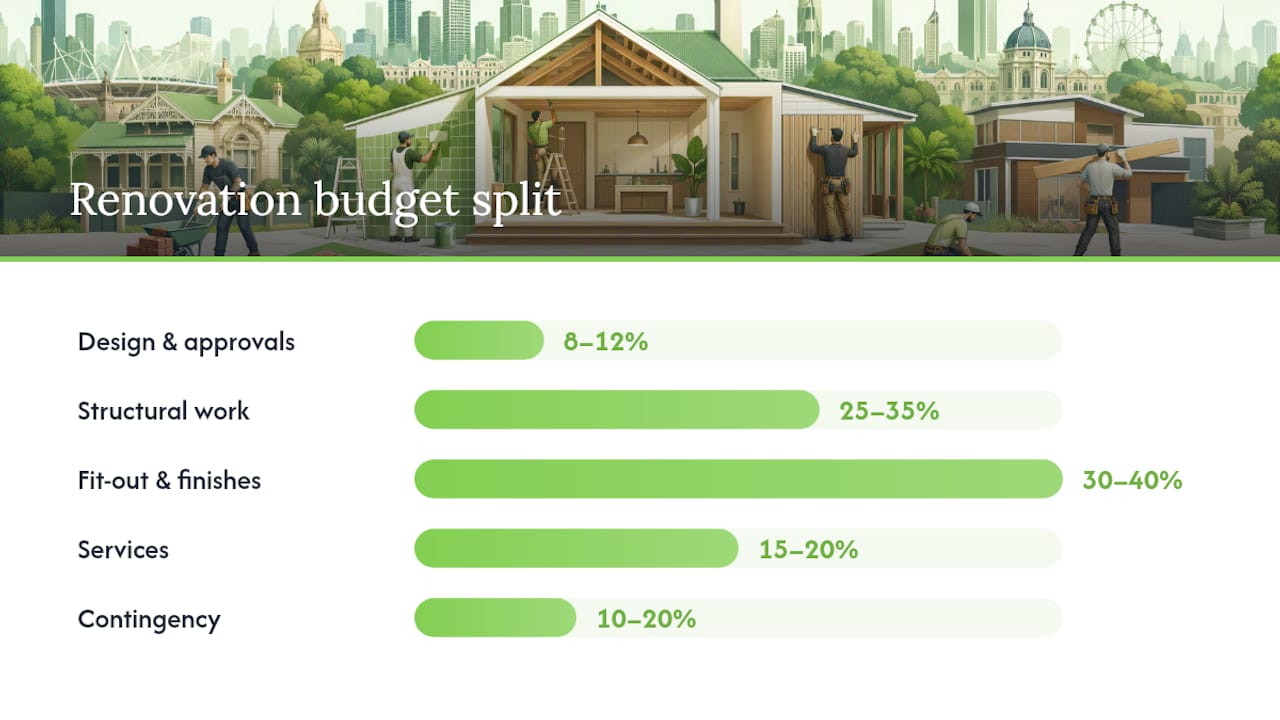
Once you know your rough total, the next job is dividing it sensibly. A defensible split for a standard renovation looks something like this:
Design and approvals: 8–12% (architect or draftsperson fees, permits, engineering)
Demolition and site prep: 5–8% (strip out, waste bins, temporary protection)
Structural work: 25–35% (framing, steel, load bearing changes, waterproofing)
Fit-out and finishes: 30–40% (cabinetry, tiling, flooring, fixtures, paint)
Services: 15–20% (electrical, plumbing, HVAC, data)
Contingency: 10–20% (held back, not spent on day one)
Some of these lines flex more than others. Design fees and demolition costs are largely fixed once you’ve settled on scope. Fit-out and finishes are where your choices matter most. Tile from a big box supplier versus an imported stone slab can shift that entire category by tens of thousands of dollars on the same floor plan.
The moment your project includes a kitchen or bathroom, expect the split to skew hard towards fit-out and services, sometimes pushing those two categories to 55 or 60% combined, simply because joinery and wet area plumbing carry so much of the cost. Structural allowance drops correspondingly if you’re not touching walls. Non-negotiable items sit in structural, services, and waterproofing. Negotiable items sit almost entirely in fit-out, meaning that’s the category to trim first if your quote comes back over budget.
How do you build a defensible renovation budget?
A number you can defend to a bank, a builder, and yourself needs to come from a process, not a guess. Here’s the sequence that actually holds up:
Define your scope and finish tier first. Write down what’s included and, just as importantly, what’s excluded, before you ask anyone for a number.
Price it trade by trade. List framing, structural, waterproofing, electrical, plumbing, joinery, tiling, and painting separately, using room allowances where you don’t yet have a firm quote.
Add pre-construction costs and contingency. Architect or designer fees, engineering, permits, and your 10 to 20% buffer sit on top of the trade total, not inside it, often lifting the final figure 25 to 40% above the raw construction cost.
Request three itemised quotes. Compare how each builder handles PC (prime cost) items and provisional sums, because that’s where identical looking quotes diverge wildly in real cost.
Choose your contract type deliberately. Fixed-price contracts shift foreseeable cost risk onto the builder; cost-plus contracts shift market and discovery risk onto you. Know which one you’re signing.
Document the variation process. Agree upfront how change orders get priced, approved, and signed before work starts, not after.
Pro Tip: Ask every builder for the same scope document before quoting. If you let each one define scope differently, you’re not comparing three quotes, you’re comparing three different projects.
What actually blows renovation budgets out?
Moving plumbing and electrical service points is the single biggest driver of unexpected cost. Relocating a kitchen sink three metres, or shifting a bathroom’s drainage stack, can add thousands in trade labour that a simple cosmetic quote never anticipated. Keeping existing service positions where the layout allows is genuinely the most effective lever you have for controlling cost.
Hidden costs catch out even experienced renovators. Budget for these before you start:
Council approvals and DA/CDC fees
Asbestos testing and removal, common in homes built before the 1990s
Temporary accommodation if the home becomes unliveable during works
Rubbish removal and skip bin hire
Tool and equipment hire for trades
These lines, along with finishing touches like window furnishings and landscaping, frequently make up the final 5 to 10% of total spend, and homeowners routinely forget to schedule them into the original budget at all. Scope creep is the other silent killer. Require signed variation forms for every change, and hold the line on finishing waterproofing and structural work before anyone starts choosing tile colours.
How does your renovation timeline affect the total cost?
A single room renovation typically takes 4 to 8 weeks. A kitchen or bathroom alone runs 6 to 10 weeks once you include lead times on cabinetry and stone. A whole house renovation stretches 4 to 9 months, and an extension with structural work can run 6 to 12 months from permit to handover.
Every extra month adds holding costs: alternate accommodation, storage for furniture, and higher day to day living expenses if you’re eating out or running two households. If you’re financing the build, interest accrues on drawn funds across that whole period. On a $300,000 build over 12 months, even modest holding and finance costs can add several thousand dollars that never appear on the builder’s quote.
What a builder wants you to know before you set a budget
Nearly 20 years of managing residential projects from design through to completion has taught us one consistent lesson: the budgets that hold together are the ones scoped in writing before the first trade sets foot on site.
When we scope a project, PC items get itemised individually rather than bundled into vague allowances, and provisional sums are minimised wherever the design allows firm pricing instead. Every variation gets documented and signed before work proceeds, which is the single biggest protection against a budget drifting sideways over the life of a build.
At quote and contract stage, homeowners should ask for:
A clear list of what’s a fixed price item versus a provisional sum
Written confirmation of contingency handling if it isn’t fully spent
A documented variation process with pricing agreed in advance
Realistic timeframes tied to the payment schedule, not just a total duration
Why the standard renovation budgeting advice sells homeowners short
Most renovation guides hand you a per-m² number and call it a day. That’s not wrong, exactly, but it’s incomplete in a way that costs people money. A rate of $3,500/m² tells you nothing about whether your project is joinery heavy or structurally simple, and those two projects can differ by tens of thousands of dollars on identical floor areas.
The advice that actually holds up under pressure is trade-by-trade pricing first, with per-m² used only as a sanity check afterwards. Homeowners who reverse that order, starting with a blended rate and working backwards, tend to under-budget fit-out and get blindsided by provisional sums later in the build.
The other gap in conventional advice is contingency discipline. On anything built before 1990, or any project touching structure, 20% is the more honest number, and treating that reserve as untouchable until it’s genuinely needed is what separates a budget that survives the build from one that doesn’t.
— Matthew
Get a scoped quote before you commit to a number
Every range in this guide is a starting point, not a substitute for pricing your specific home. There are home renovation, extension, and architectural build services available in Melbourne that manage the entire process from design through permits to completion, helping ensure the budget quoted is what you actually pay.
If you’re ready to move from ranges to real numbers, bring your existing floor plans, a rough list of inclusions and exclusions, and your contingency expectations to a scoped consultation. We’ll walk your project trade by trade rather than handing you a blended per-m² guess, and flag where provisional sums are likely before they become surprises. Whether you’re planning a full home renovation or adding floor space with an extension, the next step is a site assessment where we can put a defensible number against your specific scope.
Where these figures come from
Cost ranges draw on Building Victoria’s guidance on unexpected renovation costs, RenoGuide’s renovation cost calculator, and Yorcon’s own renovation service pages.
Sources
FAQ
What is a realistic renovation budget?
A realistic budget depends on scope, but standard mid-range renovations typically run $3,000 to $5,000 per square metre, with whole-home projects landing between $150,000 and $550,000.
How much renovation can be done with $100,000?
A mid-range kitchen renovation or a full cosmetic refresh across several rooms without moving structure or services can be covered within a modest budget, but it won’t stretch to a whole house renovation or a project involving structural changes.
Can you renovate a bathroom for $10,000?
A budget bathroom renovation sits between $8,000 and $15,000, so $10,000 can work if you’re keeping the existing layout and simply updating fixtures, tiling, and the vanity without moving plumbing.
Recommended


