
Building Defects Checklist for Owners and Inspectors

Updated: Aug 17
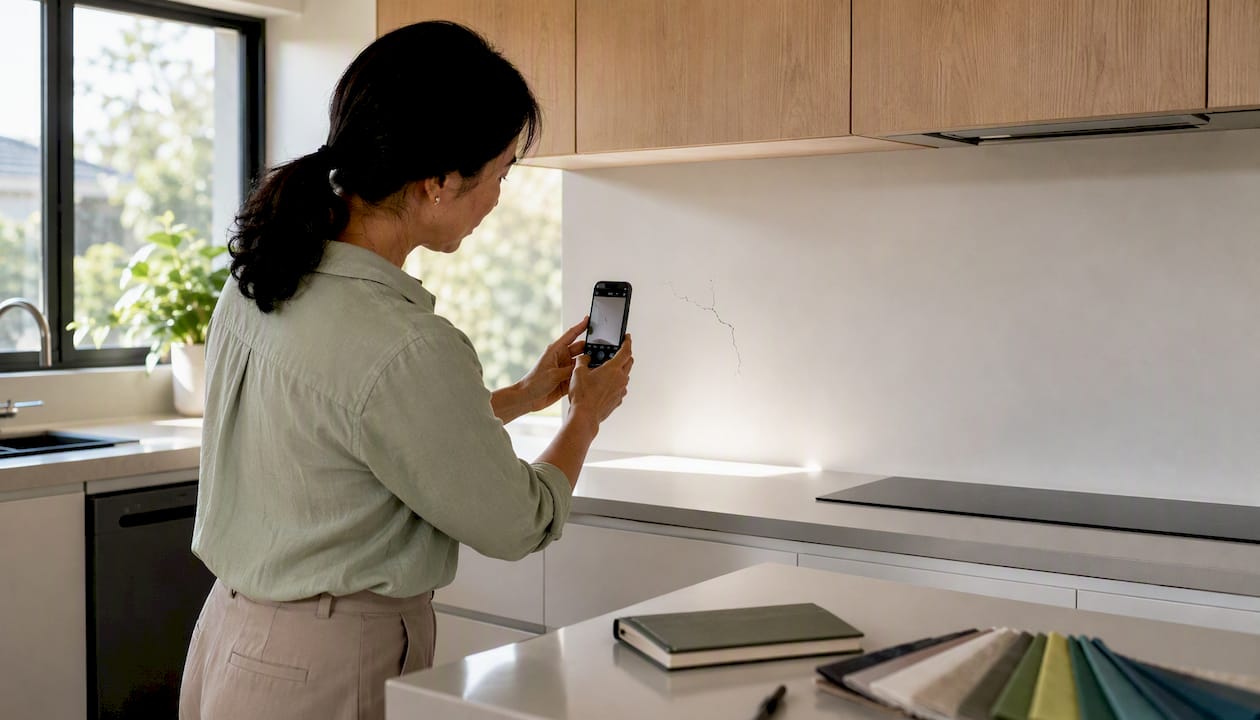
At practical completion, your single most important action is this: inspect the property thoroughly, document every defect in writing with timestamped photos, deliver the defect list to your builder by email the same day, and withhold final payment until critical items are agreed in writing. Signing handover paperwork before that shifts your leverage from contractual build responsibility to warranty management, and those two positions are not equal.
Here are the highest-priority checks to run the moment you walk through the door:
Waterproofing certificates — request AS 3740 compliance certificates for all wet areas before you accept the property; once tiles are laid, a certificate is the only practical proof a membrane exists
Active leaks or damp stains — check ceilings, roof voids, and under-sink cabinets for any sign of water ingress
Structural signs — wide slab cracks, sagging beams, or wall bulges that suggest movement beyond normal settlement
Electrical safety — test every RCD (residual current device) and confirm the switchboard is labelled; non-functional RCDs are a safety item, not a cosmetic one
Smoke alarms — confirm they are installed, interconnected, and operational per the National Construction Code
Floor falls in wet areas — water must drain toward the waste, not pool against walls or in corners
Door and window operation — every door and window should open, close, lock, and seal without binding or excessive force
Obvious finish defects — paint holidays, tile lippage, incomplete silicone beads, missing hardware, and unfinished joinery
Documentation presence — occupancy certificate, builder’s warranty, appliance manuals, and compliance certificates should be on hand at handover
Immediately after the walk-through: photograph every defect with your phone’s timestamp active, mark each item with a small piece of coloured masking tape (placed near, not on, the finish), compile the list into a written email, and send it to your builder the same day. A practical completion inspection is your final contractual opportunity to record defects before obligations shift from build responsibility to warranty work.
Pro Tip: Bring a bright torch and hold it at a raking angle across walls, floors, and ceilings. Subtle undulations, paint holidays, and tile lippage that are invisible under overhead lighting become obvious under raking light. This single technique catches more finish defects than any other on-site method.
Table of Contents
What does a complete building defects checklist cover?
A thorough property inspection checklist works trade by trade, not room by room, because defects in one system often affect adjacent ones. Use the table below as your on-site framework, then expand each row into your own defect log.
Area / Trade | Key Checks | Tolerance Reference |
Roof & gutters | Flashings seated and sealed; gutters fall to downpipes; no cracked or displaced tiles/sheets; ridge capping intact | Guide to Standards and Tolerances |
External walls & cladding | No cracking beyond hairline; weep holes clear; control joints present and sealed; render/paint even | Guide to Standards and Tolerances |
Windows & doors | Open, close, lock, and seal without binding; weather seals intact; glazing free of chips or scratches | — |
Garage & driveway | Concrete free of significant cracking; garage door auto-reverses; drainage falls away from structure | Guide to Standards and Tolerances |
Internal walls & ceilings | Plasterboard joins invisible; paint finish consistent; no bowing or cracking beyond tolerance | Guide to Standards and Tolerances |
Floors | No hollow tiles; lippage within tolerance; timber boards tight; floor falls correct in wet areas | — |
Kitchen | Cabinetry aligned and doors close flush; benchtop joins tight; splashback sealed; appliances operational | Manufacturer specs |
Bathrooms & laundries | Full silicone bead at all junctions; floor falls to waste; no hollow tiles; waterproofing certificate present | AS 3740 |
Plumbing | All taps, mixers, and toilets functional; no drips; hot water system commissioned; drainage clear | Plumbing compliance certificate |
Electrical | All circuits labelled; RCDs trip correctly; GPOs functional; light fittings secure and operational | Electrical compliance certificate |
HVAC | System operates on all settings; ducts sealed; filters fitted; condensate drains clear | Manufacturer specs |
Joinery & fitout | Doors hang square; handles and locks operate; shelving level; wardrobe tracks smooth | Guide to Standards and Tolerances |
Drainage & landscaping | Stormwater drains away from structure; no ponding within 1 m of footings; retaining walls plumb | Guide to Standards and Tolerances |
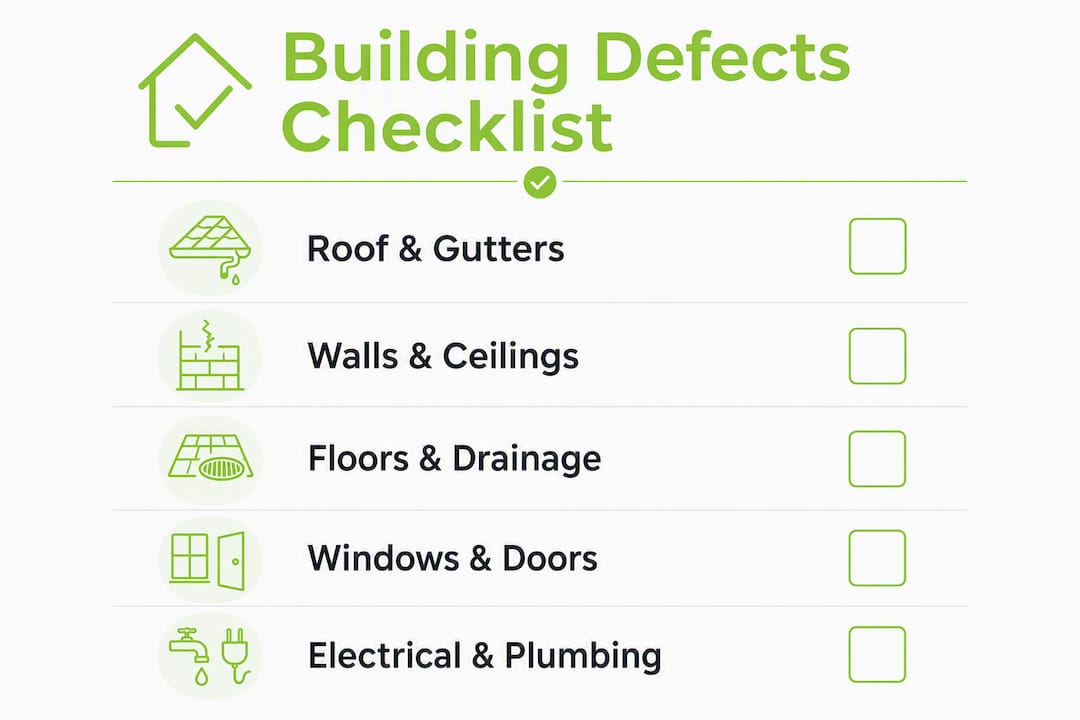
For each item you flag, record: exact location (room, wall, height), a short defect description, severity (Critical / Major / Minor), photo IDs, and your recommended action. Professional inspectors use a room-by-room inspection approach that treats wet areas and kitchens as the highest-risk zones, because floor falls, silicone continuity, and drainage function are all easy to miss without deliberate testing.
On-site kit to bring:
Bright torch (for raking light across surfaces)
Spirit level and tape measure
Phone or camera with timestamp enabled
Colored masking tape for defect tags
Printed or digital defect log template
Marble or golf ball (to test floor falls)
Pro Tip: A golf ball or marble rolled across a shower floor tells you immediately whether the fall runs toward the waste or toward a wall junction. It takes five seconds and catches a defect that can cost thousands to rectify once tiles are grouted.

What are the different types of building defects, and how do you prioritise them?
Not every defect carries the same weight, and understanding the categories helps you decide what to push back on immediately versus what can wait for a scheduled rectification visit.
Patent defects are visible and discoverable during a reasonable inspection. A cracked tile, a door that won’t latch, a paint run — these are patent. Capturing them at handover is critical because once you accept the property, your leverage to demand rectification under the build contract weakens considerably. Latent defects are hidden at the time of handover and only emerge later, often after finishes conceal critical systems. A waterproofing membrane that was never properly applied is a classic latent defect: you won’t see it until water starts tracking through a ceiling. Experts emphasise that homeowners should capture every patent defect at handover precisely because latent defects, once they surface, shift rectification cost and responsibility into murkier territory.
The second distinction is structural or safety defects versus cosmetic or finish defects. These two categories demand very different responses.
Critical (structural/safety): Wide slab cracks, sagging structural members, non-functional RCDs, missing smoke alarms, active water ingress, or absent waterproofing certification. Do not accept the property. These items must be resolved or formally agreed before handover proceeds.
Major (significant defects): Tile lippage beyond tolerance, doors that bind or won’t seal, incomplete silicone beads in wet areas, drainage that ponds near footings, or missing compliance certificates. Withhold final payment or negotiate a written holdback and schedule rectification within an agreed timeframe.
Minor (cosmetic): Paint touch-ups, minor scratches, small grout gaps, loose hardware. Accept with a written defect list and a confirmed rectification date.
Pro Tip: If your defect list has fewer than 10 items on a new build, treat that as a signal the inspection was rushed, not that the build was perfect. Professional inspectors consistently find a large proportion of newly built Australian homes contain at least one defect at handover, and routinely uncover dozens of defects on mainstream builder homes. A short list is reassuring only when it follows a genuinely thorough walk-through.
How do you document building defects so they hold up?
Good documentation is what separates a defect list that gets actioned from one that gets disputed. The goal is a record clear enough that a third party, whether a mediator or a tribunal, can understand exactly what was found, where, and when.
Photo protocol:
Shoot a context photo first (the whole room or wall), then a close-up of the defect
Hold the torch at a raking angle for surface defects so the shadow reveals the issue
Place a colored masking tape tag near the defect and include it in the close-up shot
Never edit or filter photos; keep originals with device timestamps intact
Template fields to capture for every defect:
Field | Example Entry |
Inspector / owner name | Jane Smith |
Location | Ensuite, east wall, above floor |
Defect description | Silicone bead missing at wall-to-floor junction |
Severity | Major |
Contract / spec reference | Drawing, AS 3740 |
Recommended action | Remove grout, apply continuous silicone bead, re-grout |
Notify | Builder (site supervisor) |
Once the log is complete, email it to your builder the same day with photos attached and a location plan if the property is large. Request a written rectification timeline in return and keep every reply. Professional inspectors recommend same-day written defect reports because verbal agreements at handover are almost impossible to enforce later.

What certificates and standards should you request at handover in Australia?
Australian handover is not just about what you can see. The documents you receive at practical completion are as important as the physical inspection, because several critical systems are concealed by finishes before you ever walk through the door.
Documents to request before accepting handover:
Occupancy certificate / final inspection certificate — issued by the relevant building surveyor; confirms the building is fit for occupation
Defect prevalence at handover: Industry inspections consistently find that a large proportion of newly built Australian homes contain at least one defect at handover, ranging from minor cosmetic issues to structural concerns. Waterproofing is consistently ranked among the top three defect categories, and it is the one category where a missing certificate cannot be remedied without destructive testing once tiles are in place.
The Guide to Standards and Tolerances, published by the Victorian Building Authority (VBA), is the objective benchmark for workmanship tolerances where contracts are silent. If your builder disputes whether a finish meets the required standard, this document is the reference point. For unresolved defects in Victoria, the Building and Plumbing Commission (BPC) and the VBA are the primary dispute pathways. The BPC handles complaints about defective or incomplete work, while the VBA can issue a Direction to Fix non-compliant building work under the Building Act 1993.
A practical note on certificates: a compliance certificate issued by a licensed tradesperson is proof of regulatory compliance. A contractor-issued warranty is a commercial promise. They are not interchangeable. If a builder offers a warranty in lieu of a waterproofing certificate, that is not an acceptable substitute.
Understanding the full building process helps you know exactly when each certificate should be issued and what to ask for at each stage.
What should you do after finding defects at handover?
Finding defects is not the end of the process. It is the beginning of a documented, time-bound negotiation, and how you handle the next 48 hours matters more than most owners realise.
Immediate actions (same day):
Do not sign the handover certificate if Critical or Major defects are unresolved
Compile your defect log and email it to the builder with photos and a location plan
Request a written rectification timeline with specific completion dates for each item
Keep a copy of every communication, including read receipts where possible
Customer-side process (days 1–14):
Schedule a re-inspection date at the time you issue the defect list
If your contract permits, withhold final payment or negotiate a formal holdback against unresolved items; always read your contract terms before doing this and seek independent advice for significant amounts
Document all phone calls with a follow-up email confirming what was discussed
If the builder does not respond or refuses to rectify:
Engage an independent inspector — a structural engineer for structural concerns, a waterproofing specialist for wet-area issues, or a licensed electrician for electrical safety items
Escalate to the relevant state body: in Victoria, the BPC and VBA handle complaints about defective work; in Queensland, the Queensland Building and Construction Commission (QBCC) manages the practical completion inspection process
For unresolved disputes, the Victorian Civil and Administrative Tribunal (VCAT) or equivalent state tribunal is the formal resolution pathway
Pro Tip: Withholding final payment is a legitimate tool, but it must be exercised carefully. Check your contract for the exact payment trigger at practical completion, confirm the defects are genuinely unresolved, and seek independent legal advice before withholding a significant sum. A well-documented defect list is your strongest asset in any dispute.
Understanding what to expect after signing a building contract gives you a clearer picture of your rights and obligations at each milestone.
Which defects should trigger an immediate specialist inspection?
Some findings at handover are not a matter of negotiating a rectification date. They are a signal to pause the handover entirely and call a specialist before you accept the property.
Structural movement: Cracks in slabs wider than 3 mm, wall bulges, sagging beams or lintels, or cracks that propagate visibly over days. Call a structural engineer before proceeding.
Missing waterproofing certification in wet areas: If the builder cannot produce an AS 3740 certificate for showers, bathrooms, or balconies, do not accept those areas. Once tiled, the only alternative is destructive testing or a leak test, both of which are expensive and disruptive.
Ponding on balconies or persistent damp stains: Water pooling on a balcony or damp patches tracking through a ceiling or roof void suggest drainage failure or membrane breach. A waterproofing consultant can assess without destructive work in many cases.
Electrical hazards: Exposed wiring, RCDs that fail to trip, an unlabelled switchboard, or safety switches missing from circuits that require them. Stop occupation and call a licensed electrician.
Fire safety and compliance gaps: Smoke alarms that are absent, not interconnected, or non-functional; fire-rated doors that have been penetrated or do not close and latch correctly; compromised party-wall fire ratings in attached dwellings.
Drainage directed toward the structure: Stormwater or surface water that flows toward footings rather than away from them is a long-term structural risk, not a cosmetic issue.
When in doubt, the cost of a specialist inspection is small relative to the cost of accepting a defective building. A structural engineer, waterproofing consultant, or licensed electrician can typically provide a written assessment within a few days, and that report becomes part of your evidence file if the dispute escalates.
Why is waterproofing the top priority on any defect inspection?
Waterproofing sits at the top of every serious building inspection report for one practical reason: once a wet area is tiled, the membrane is invisible. A certificate is the only non-destructive proof it was installed correctly.
Industry inspections consistently show that water-related defects rank among the top three categories in newly completed Australian homes. The consequences are disproportionate to the original cost of the work. A failed shower membrane can saturate a subfloor, rot framing, and generate mould remediation costs that dwarf the original tiling contract. The AS 3740 standard sets the requirements for waterproofing of domestic wet areas, and compliance certificates issued against that standard are the primary evidence that the work was done and inspected before finishes were applied.
Why the certificate matters so much: Waterproofing certification under AS 3740 is the only practical proof of membrane work once the area is tiled. Specialists consistently recommend obtaining that certificate before final payment, because retrospective proof requires either a leak test or destructive removal of tiles.
The practical consequence for owners is straightforward: request the waterproofing certificate at the same time you request the occupancy certificate, and treat an absent certificate as a Critical defect, not a paperwork oversight. Builders who cannot produce one should be asked to arrange a licensed waterproofing inspector to conduct a water test before handover proceeds.
Pro Tip: Ask your builder to show you the waterproofing inspection sign-off in the site diary or inspection record, not just the certificate. A certificate with no corresponding site record is worth less than one that can be traced to a specific inspection date and inspector.
Printable sample checklist table for on-site use
Copy or print this table and bring it to your inspection. Fill in each row as you move through the property, then transfer the completed log to your email report the same day.
Header fields to add at the top of your printed template:
Owner name / Inspector name
Property address
Date and time of inspection
Plan reference / contract number
Area / Item | Check Performed | Notes | Severity (C/M/m) | Photo IDs | Action Required |
Roof — flashings | Seated and sealed at all penetrations | ||||
Roof — gutters | Fall to downpipes; no debris | ||||
External walls | No cracking beyond hairline; weep holes clear | ||||
Windows | Open, close, lock, seal without binding | ||||
Doors — external | Weather seal intact; threshold clear | ||||
Internal walls | Paint consistent; no bowing | ||||
Ceilings | No cracking, staining, or sagging | ||||
Floors — tiles | No hollow tiles; lippage within tolerance | ||||
Floors — timber | Boards tight; no squeaks | ||||
Kitchen — cabinetry | Doors flush; handles secure | ||||
Kitchen — appliances | All operational; manuals present | ||||
Bathroom — waterproofing | Certificate present; floor falls to waste | ||||
Bathroom — silicone | Full bead at all wall/floor junctions | ||||
Plumbing | No drips; drainage clear; HWS commissioned | ||||
Electrical | RCDs trip; all circuits labelled | ||||
Smoke alarms | Installed, interconnected, operational | ||||
HVAC | All settings operational; filters fitted | ||||
Joinery | Doors hang square; tracks smooth | ||||
Drainage / landscaping | Falls away from structure; no ponding | ||||
Documents | Occupancy cert, waterproofing cert, electrical cert, plumbing cert, builder’s warranty, appliance manuals |
Severity key: C = Critical (do not accept), M = Major (withhold payment / schedule rectification), m = Minor (accept with written defect list)
On-site workflow: tag each defect with colored masking tape as you go, photograph the tag alongside the defect for context, then sync your completed table to an email report before you leave the site. This sequence means your defect list is timestamped, photographed, and delivered the same day, which is the standard professional inspectors use.
Key Takeaways
A thorough building defects checklist, delivered in writing with timestamped photos on the day of handover, is the single most effective tool for protecting your rights and securing fast rectification.
Point | Details |
Inspect with raking light | Hold a torch at a low angle across walls, floors, and ceilings to reveal finish defects invisible under overhead lighting. |
Always request waterproofing certificates | AS 3740 compliance certificates are the only non-destructive proof a membrane exists once wet areas are tiled. |
Issue the defect list same day | Email your written defect log with timestamped photos to the builder on the day of inspection to preserve contractual leverage. |
Do not sign handover for unresolved Critical items | Signing shifts obligations from build contract responsibility to warranty management, significantly reducing your leverage. |
Escalate through state regulators when needed | In Victoria, the BPC and VBA handle unresolved defect complaints; in Queensland, the QBCC manages the practical completion process. |
Yorcon’s approach | Yorcon manages staged inspections, documented defect lists, and transparent rectification timelines to reduce handover defects on Melbourne builds. |
The defect list nobody wants to find — but everyone should
There is a tendency among owners to feel relieved when a handover inspection produces a short list. We understand that instinct completely. After months of construction, the last thing anyone wants is more delays. But a short defect list on a new build is not always good news. It can mean the inspection was thorough and the build was excellent, or it can mean the inspection was rushed and the defects are waiting to be discovered after the keys are handed over.
The distinction between patent and latent defects is where this gets consequential. Patent defects found at handover are your builder’s contractual obligation to fix under the build contract. Latent defects that surface six months later, after finishes have concealed the underlying cause, become a warranty claim, and warranty claims are slower, harder to enforce, and more likely to end up in dispute. The waterproofing certificate issue is the clearest example of this dynamic: a missing certificate at handover is a minor paperwork problem that takes a phone call to resolve. A failed membrane discovered two years later, after water has tracked through a subfloor, is a major remediation project.
What we have seen over nearly 20 years of residential construction in Melbourne is that the owners who have the smoothest post-handover experience are the ones who were most thorough at practical completion, not the ones who were most accommodating. Being thorough is not adversarial. It is the professional standard, and any builder worth working with will respect it.
Yorcon builds quality in before handover day arrives
Most handover defect lists are the result of gaps in the construction process, not just the final inspection. When project management is integrated from design through to practical completion, with staged inspections at each trade milestone, the defect count at handover is typically far lower and the items that do appear are minor.

At Yorcon, we manage the entire build process for Melbourne homeowners, from design and permits through to handover, with documented quality checks at every stage. Our clients receive a clear defect management process: a written defect list at practical completion, scheduled re-inspections, and transparent communication at every step. Whether you are planning a home extension, a full architectural build, or a heritage renovation, the quality of the handover reflects the quality of everything that came before it.
If you are planning a build or renovation in Melbourne and want a builder who treats the handover as seriously as the foundation, contact Yorcon to discuss your project.
Useful Australian sources to consult
These are the primary references for certificates, tolerances, and dispute pathways in Australia.
Guide to Standards and Tolerances (VBA) — the benchmark for acceptable workmanship in domestic construction where contracts are silent on finish tolerances; use this when assessing whether a defect meets the threshold for rectification
Building and Plumbing Commission (BPC) — Victoria’s primary body for complaints about defective or incomplete domestic building work; first port of call for unresolved defects in Victoria
Victorian Building Authority (VBA) — issues Directions to Fix non-compliant building work under the Building Act 1993; relevant when a defect constitutes a non-compliance rather than a workmanship dispute
Queensland Building and Construction Commission (QBCC) — manages the practical completion inspection process and dispute resolution for Queensland owners
Standards Australia (AS 3740) — the standard for waterproofing of domestic wet areas; the reference document for waterproofing compliance certificates
Consumer Affairs Victoria — Domestic Building Consumer Guide — covers statutory warranties, major domestic building contracts, and home warranty insurance for Victorian owners
Recommended


